The latest issue of Records, the Fellowship’s annual journal, is now available to members and contains essays by Major (retd) Phil Watson, Richard Earl, and Crispin Wright, amongst others.
This discussion on the road to unity of command on the Western Front in 1918 by current Haig Fellow Dr John Spencer also features:
Records is published annually and is exclusive to DHF members. Join today and receive this year’s issue [link to membership page here]
THE ROAD TO UNITY OF COMMAND ON THE WESTERN FRONT 1918*
John Spencer
A few minutes after noon on 26 March 1918 the French Prime Minister Georges Clemenceau and his Army’s Chief of Staff General Ferdinand Foch strode up the marble steps of a provincial town hall for a meeting which would change the course of Allied leadership in the Great War. The mood in the first-floor meeting room in Hotel De Ville of the small French market town of Doullens was as cold and gloomy as the weather, yet the decisions taken over the next couple of hours would lead to victory on the Western Front before the end of the year. Waiting for them was General Philippe Pétain, the Commander-in-Chief (C-in-C) of the French armies on the western front, and the C-in-C of the British forces in France and Flanders, Field Marshal Sir Douglas Haig and his staff. Five days earlier, Haig’s British Expeditionary Force (BEF) had been attacked by a German force of overwhelming strength. By the day of the meeting the enemy, advancing on a 43-mile front north of the River Somme, were on the outskirts of Albert and just 20 miles short of the vital rail and logistics centre at Amiens. The situation was critical, hence the presence of Clemenceau, the French President Raymond Poincaré, and Viscount, the strong man of the British War Cabinet, soon to become the British Secretary of State for War. Although Milner was officially ‘without portfolio’, the British Prime Minister David Lloyd George had given him wide discretion politically. He was assisted by the Chief of the Imperial General Staff, General Sir Henry Wilson, Foch’s friend and opposite number. This was significant in that Wilson had been influential in developing the military advisory committee of the Supreme War Council, a committee of which Foch was also chair. But Foch was a chairman without power and had no troops under his direct command.[1]
Haig’s outnumbered forces in the south had been pushed back relentlessly, and French reinforcements seemed to him slow in coming to the BEF’s aid. Desperate times called for desperate measures. The conference, with a speed and unanimity usually elusive at such meetings, authorised Foch to ‘co-ordinate’ British and French forces in the west. Less than three weeks later he was empowered to issue orders to those same armies, plus those of the American Expeditionary Forces (AEF) with the title of ‘General-in-Chief’, more familiarly ‘Generalissimo’.[2] Thus, Unity of Command, a concept which had evaded the Allies since August 1914,[3] had finally been established. With the benefit of hindsight, the logic and common sense underpinning this decision is obvious; after all, it resulted in close co-operation between British and French forces at a moment of real crisis and, ultimately, to victory for the Allied cause. In fact, unity of command had long been favoured by French generals and opposed with equal fervour by their British colleagues. It was by no means a foregone conclusion that this would be adopted as a response to the crisis facing the Entente armies in the spring of 1918. This chapter examines the pressures which led to such a fundamental change in the Anglo-French approach to military policy, including a crisis of manpower and the dysfunctional nature of civil-military relations in Britain. It also considers the effects of this shift on the control of the Allied armies on the Western Front.
The absence of a formal agreement on the role, and the status, of the BEF which crossed the English Channel in 1914 lay at the heart of the long-running strains within the Anglo-French alliance. Officially sanctioned military staff talks had taken place in the decade following the signing of the Entente Cordiale in April 1904 but at a political level the British government had adopted a policy of strategic ambiguity.[4] As armies were mobilising across Europe, France had a formal alliance with Russia, promising mutual assistance in the face of German aggression, but not with Great Britain. The sheer speed and growth of the diplomatic crisis in late July and early August 1914 meant that neither soldiers nor statesmen were certain of how Britain would react; whether the country would go to war against Germany or not. Once the decision to fight had been taken, and British mobilisation plans put into action, Field Marshal Lord Kitchener, the newly appointed Secretary of State for War, spelt out the principles governing the actions of the BEF’s C-in-C Field Marshal Sir John French: ‘The special motive of the force under your control is to support and co-operate with the French Army against our common enemies.’ While ‘every effort must be made to coincide most sympathetically with the plans and wishes of our Ally’ the limited strength of the British force meant that Sir John had to strive to keep casualties to a minimum and to avoid large scale action when not in support of the French. Kitchener’s next words set the scene for the tensions and misunderstandings which, once embedded, were to dog the Anglo-French alliance for the rest of the war: ‘In this connection I wish you distinctly to understand that your command is an entirely independent one, and that you will in no case come in any sense under the orders of any Allied General.’[5] Unsurprisingly, considering the relatively small size of the BEF, together with the fact that the fighting was taking place on French, and Belgian, soil the French C-in-C General Joseph Joffre, assumed he had the mantle of Generalissimo, and behaved accordingly. This led to ill-tempered spats, misconceptions and ill-feeling with the diminutive forces of their British and Belgian allies, not all of them France’s fault. Yet in a scramble these ill-coordinated allied forces turned back the German tide and then held it at bay.[6] Joffre realised that flattery and brutality might both have their uses with a man like Sir John Ferench, but equally understandably, Sir John and his staff baulked at frequent displays of French hauteur. It was an avoidable state of affairs which wasted time, effort, and most importantly, goodwill. Lord Esher, the British courtier who freelanced as unofficial diplomat and liaison officer in Paris summed up the situation:
The difference of view between Joffre and the Field-Marshal [French] as to their respective positions is embarrassing and absurd; all the result of want of frankness. Joffre believes that he is Generalissimo over both armies. The Field-Marshal says that the English army would never yield its best under such circumstances, and that he holds an official letter from Lord K. in which he is told that he is the Commander-in-Chief of an Allied Force, and that the Government holds him responsible and no one else.[7]
Inexplicably, it took until the end of March 1915 – almost eight months after the BEF first set foot on French soil – for the British to finally disclose to their ally the particulars of Sir John’s order. Esher broke the news to Alexandre Millerand the French War Minister who, he told Sir John, was ‘thunderstruck’:
He had received quite the contrary impression! Joffre has been allowed to think from the beginning that you had been instructed to act under him, that the refusal to do so came from you, and that the Government were too weak to insist. In my opinion this misunderstanding is the cause of everything unpleasant in the atmosphere of the Allied Armies. I pointed out to Millerand that before the war commenced, and at the opening of hostilities, you were ready to serve under Joffre; but that now it is impossible. He sees this. I said to him that the English people would misconstrue it. He agrees that it is too late.[8]
In fact, the events of March 1918 were not without precedent. In the fluid period beginning mid-September 1914, during the so-called ‘Race to the Sea’, French, British and Belgian armies in Flanders fought together against the Germans, each side desperately attempting to envelop the other. In this, the final phase of the war of manoeuvre on the Western Front until 1918, events forced the Allies to work in unison. On 8 October Joffre appointed Foch, then commanding the French XX Army at the northern extremity of the allied line, as his adjoint (deputy/assistant) to coordinate the French, British and Belgian forces.[9] The logic of this decision, and the willingness of the British in particular to accept, however informally, Foch’s role, illustrated that when the seriousness of the situation demanded it concessions towards co-operation could be made; but not easily. Days after Foch’s appointment he asked the British to assist the Belgians to the north of the Ypres Salient. Always ready to take offence, Sir John exclaimed that ‘he would be d______ if he would be dictated to by Foch who had better mind is own business’.[10] French was a mercurial character, proud of his field marshal’s baton, and his reluctance to be directed by Foch, an officer he considered his junior is perhaps understandable. In fact ‘[Sir John] French, by and large – and this was true for the BEF as a whole–firmly placed the independence of his command well above support and co-operation with the French army.’ [11]Despite these tensions the arrangement ran reasonably smoothly during the First Battle of Ypres, which began on 19 October. Foch brought ‘energy and determination, not operational insight’, but it was a timely contribution.[12] When the crisis subsided a month later, and the Belgian town was held, Sir Henry Wilson, then Sir John’s Sub-Chief of Staff, noted the fundamental reality that the British and French troops had been ‘so mixed up’ that ‘no orders can be given without the other’s approval’.[13] It was an important lesson in which tact and diplomacy had shown its value and one which neither Foch nor Haig would forget.[14] It was co-operation under a co-ordinating authority, but it was not unity of command. It would be three and a half years before anything of the sort emerged.
Once the war of movement was over, and trench warfare became the order of the day, the British and French commanders eased themselves away from the arrangement which had produced short-term benefits for the Allied cause. In 1915 the French effort far outstretched the British contribution. Inevitably, therefore, it was the French, and specifically General Joffre who decided Franco-British military strategy. Unfortunately, tact and diplomacy were not amongst Joffre’s, or Sir John’s, virtues and there were regular rows between them. The French always wanted more from the British who, anxious to build and train their new armies, chafed at the implication that they were not doing ‘their bit’. Henry Wilson, by this time principal liaison officer with the French Army, did important ‘diplomatic’ work between the two staffs.[15] A long-standing friend of Foch, Wilson was often criticised by his British colleagues for being overly supportive of the French. In fact, he was far from a mere dupe and, as we shall see, played a crucial and often critical role in the decisions of March 1918 and subsequently. The inability of the Entente partners to trust each other and co-operate fully was made worse by internal pressures. The French government was fractured and riven with infighting, a problem which often spilled over into strategic decision making. The British also suffered from major differences of opinion inside both the government and the high command of the army. Asquith’s qualities as a peacetime Premier were not those most needed for strong leadership in war. Kitchener of Khartoum was in turn assailed by critics inside and outside the Cabinet who believed, with justification, that he was secretive, reluctant to delegate, and was struggling to formulate a strategy to achieve victory. In this latter, at least, he was not alone. French resented what he saw as interference from London in the tall and uncompromising form of ‘K of K’. If Kitchener and French were fire and petrol, Henry Wilson and William Robertson were chalk and cheese. Wilson, although highly intelligent was flippant, loved intrigue and gossip and was comfortable hobnobbing with politicians. Robertson, who had become French’s Chief of General Staff in January 1915 in place of Archie Murray (whom the French had found despicably difficult to work with) was dour, precise, and a fearsomely effective administrator. Wilson had wanted the job. Sir John had also wanted Wilson, but the Prime Minister H.H. Asquith vetoed the proposal. Tensions at the highest level within the BEF, within the civil-military partnership, and as much grit as oil in the machinery of the Anglo-French partnership, meant that any form of unity of action was difficult to come by in 1915. The Battle of Loos, undertaken at French insistence, and which began on 25 September in support of their own wider offensive (the Third Battle of Artois) on the BEF’s right, was a costly and disappointing encounter. It was the final straw for Sir John’s critics, military and political, and a stark example of Anglo-French bickering. Joffre failed to provide adequate artillery support to the British action, as originally promised, due to demands on his own operation.[16] Robertson, soon to be appointed Chief of the Imperial General Staff (CIGS) summed up the frustration and distrust at GHQ to the King’s private secretary Lord Stamfordham:
Foch has also been causing a delay. First he said he would be ready today, then tomorrow, now it is later. It is very tiresome, as well as fatiguing for our troops. We make preparations for a certain day and then find that we are unable to proceed because our friends on our right are not ready. The French are most unbusinesslike people. I think it quite true to say that their Staff is far inferior to ours, and they certainly set no value on keeping to arrangements made beforehand, and indeed suggested by themselves. However there has always been this kind of trouble in fighting with allies, and there always will be. War is a one-man business, both in the field and at home, and always has been.[17]
By 1916 the BEF, now under Haig, was reaching a scale which meant it had to be taken more seriously by its French ally. Unfortunately, the tensions and misunderstandings which had marred the previous year were still evident, in spite of the fact that the British had accepted. Joffre’s plan for a combined and roughly simultaneous Russian, French and British offensive. The German assault on Verdun in February dominated the first half of the year and made the Battle of the Somme both inevitable and essential. The heavy toll of the ‘Mill on the Meuse’ meant that the French involvement in the long-planned summer offensive was much reduced from the numbers agreed originally. Apart from supporting the right of the British line early in the battle, the British north of the river Somme and French to the south, fought alongside each other, but effectively in separate battles. The French, rightly on the whole, considered British operational tactics and skills lamentable and preferred their own way of making war; consequently the allies fought a joint enterprise but were never ‘joined’. [18] This was made worse because the allies were fighting a coalition war without previous agreement on any of the fundamental issues which would inevitably arise. It was hardly surprising that the British and French commanders found themselves at odds when their political leaders were uncertain of the extent and nature of the co-operation they had tacitly allowed to develop. In 1916 there was a degree of cooperation but no prospect of unitary command of the two main allied armies on the Western Front. This could only have been under a French general and even if Britain’s senior soldiers and politicians had been sympathetic to the notion – and they were not – the general public would not have stood for it.
*****
In the final two years of the Great War manpower, or rather the shortage thereof, dominated the plans of all the protagonists. The costs to the Allies of the battles of 1917 meant that by the end of that year the question was could they hold on until the Americans could swing the balance, once they declared war on Germany in April 1917. But the AEF needed training, and it was not until February 1918 that they had one division actually in the line in France, with five more training behind the lines. A second division was in the line by 1 March.[19] A German offensive, bolstered by hardened veterans no longer required on the Eastern Front, was considered inevitable. The challenge of manpower, rather than the machinations of politicians and their military commanders, lay at the heart of the establishment of unity of command on the Western Front in March 1918. It also lay at the heart of the tensions and distrust in British civil-military relations.
Long before entering 10 Downing Street, David Lloyd George had been convinced there was a better strategy to the one favoured by his nation’s generals. The ‘Easterners versus Westerners’ debate; seeking alternative theatres where the ‘butcher’s bill’ might be smaller than that exacted in France and Flanders is well known. The failure to find such a solution, be it at Gallipoli, Macedonia, or the Middle East, or in Italy, had not assuaged Lloyd George’s appetite for trying. In early 1917, appalled by the British losses on the Somme and frustrated by what he saw as the blinkered obduracy of the Haig-Robertson alliance, he moved to place the British army under the command of a French general.[20] The eponymous Nivelle Offensive failed to achieve its grandiose aims, despite a casualty list so high that the French Army suffered widespread and prolonged outbreaks of indiscipline. With doubts about French willingness to press the offensive, in Britain the balance of civil-military authority tilted away from the politicians and the soldiers found themselves free to wage the battles of Third Ypres and Cambrai. The enormous cost of these offensives, to little obvious advantage, meant that by the end of the year the Prime Minister was once again in the ascendant. But his tenuous hold on power meant he had to tread warily. As a Liberal leader of a Conservative dominated coalition government, Lloyd George had a tiger by the tail. A significant number of those who kept him in power supported the military leadership and were suspicious of the Premier’s motivations. As a result, in the autumn of 1917 he turned to another soldier, Henry Wilson, to advise on military options for 1918. Wilson disappointed the prime minister by ruling out a new offensive in the Middle East. By contrast, his other main recommendation, the establishment of an overarching body to examine future strategic proposals was music to the Prime Minister’s ears.[21] Within six months a vague concept had become the Supreme War Council (SWC). Based at the Palace of Versailles outside Paris, and subject to political oversight from the British, French, Italian and US governments, its military staffs – including Wilson and his long-time friend Foch – ‘finally established a mechanism for strategic assessment and planning, cross-alliance resource coordination and management.’[22] Disagreements were inevitable, but at last there was a structured forum for dealing with them. The greatest defect of the scheme was that for British domestic political reasons it did not designate an office of supreme military command. Even Wilson was suspicious of such a post and when a Supremo was suggested by General Jan Smuts, a member of the War Cabinet, for a Middle Eastern theatre Wilson was hostile
Lloyd George saw the SWC as a vehicle to circumvent what he saw as the uncompromising strategic domination of the British high command. As far as he was concerned, the generals’ seemingly limitless demands for men were unacceptable, both morally and practically. As 1918 dawned, in terms of matériel Britain might have been able to fight a ‘rich man’s war’ for the only time in its history.[23] When it came to men for the front, it was a different story entirely. In October 1917, in response to the government’s ongoing failure to develop a coherent manpower policy, the Ministry of National Service was created, headed by Sir Auckland Geddes.[24] He was required ‘somehow to utilise better–given the powers provided him by the State–what human resources were left to his care’. The adverb ‘somehow’ carried a grim pertinence. On 13 October he presented the War Cabinet with a ‘shocking’ document.[25] The whole country was ‘close to the limit of its human resources’. He assumed a military ‘wastage’ total for the period 1October 1917 to 30 September 1918 of 800,000 men across all theatres: in line with losses of the previous 12 months. Even with radical changes to recruiting rules, only about half the predicted losses could be made up in the coming year.[26] Days earlier Haig and Robertson had both submitted strategic proposals for 1918 which, essentially, recommended more of the same–another major offensive in the west.[27] Wilson’s alternative, in addition to what became the SWC, favoured a defensive posture on the Western Front (until the Americans were properly trained and in meaningful numbers) with limited operations elsewhere. As Minister of Munitions Winston Churchill recommended that recruitment to the military be kept low with all available labour, especially skilled labour, employed on shipbuilding, artillery and aircraft.[28] Concentrating manpower on war production rather than manning the trenches might have appeared sound thinking, but military losses in 1917 had been catastrophic and could not be ignored. The War Office casualty report for the period 1 January to 30 November 1917 showed 753,147 men killed, wounded, missing or taken prisoner, with 690,218 of those in France and Flanders.[29] Rather than helping Haig and Robertson’s case for more men, the statistics served to harden the War Cabinet’s resolve to take control of manpower priorities.
The result was that in December the government established the Cabinet Committee on Man-Power.[30] Its conclusions placed the army at the bottom of the list of manpower priorities for 1918.[31] It gave precedence to the Royal and Merchant navies, crucial as these were in sustaining Britain during what was expected to be a year of retrenchment; it was also essential to be capable of transporting men and equipment from the US to make a decisive difference in 1919. The army came last, after shipbuilding, aircraft, tank and food production. It would receive just 100,000 ‘Category A’ men in the year, rather than the 600,000 the War Office estimated was needed. The report also recommended that front-line divisions be reduced, from 12 battalions (plus one Pioneer battalion), to nine battalions (plus one Pioneer battalion).[32] If Lloyd George could not limit Haig’s strategic ambitions by argument and persuasion he was determined to do so by prioritising other sectors of the war economy, and by holding troops back in the UK.[33] The new SWC seemed to confirm the view that the west was strongly insured so that an equilibrium existed there, thus permitting an allied major offensive in more distant theatres. The reduction in British divisional strengths in France was forced through, disorganising operational rosters etc, and a major extension of the British front so as to ease the French line was insisted upon. This was close to the old Somme battlefield and was thought by the home and Versailles authorities to be safe from attack.[34]
The end result of these actions was that when the offensive the Germans called ‘Operation Michael’ opened on the morning of 21 March 1918 the British line, weakened by its extension southwards, was especially vulnerable at its junction with the French. At that point the British Fifth Army, consisting of 12 infantry and three cavalry divisions was deployed along a front of 42 miles. To its north, Third Army had 14 division along a front of 28 miles. Following the largest artillery bombardment in history to that date, 68 German divisions, attacked in waves across a battle zone shrouded in thick fog. It is hardly surprising that the Germans succeeded in pushing the defenders back.[35] The crisis which finally forced the British to accept a unified command on the Western Front had arrived.
*****
By the beginning of 1918 it was clear to the allies that a German offensive was inevitable, and that it would not be long delayed. The only questions were the date of the attack, and the location. By March evidence was building which answered, within reasonable parameters of error, both questions. Lieutenant General Sir Herbert Lawrence, the BEF’s recently appointed CGS, told an Army commander’s conference on 3 March that ‘the Germans will attack and will attack soon…We must be ready for a German offensive from now onwards. The offensive is not likely to be delayed beyond March.’[36] The main thrust of the enemy assault was expected to fall on the British Third and Fifth Armies in the Cambrai area of the old Somme battlefields.[37] The next day Major General Sir Frederick Maurice, Director of Military Operations at the War Office noted evidence of enemy preparations in the Somme sector, southwards to the junction of the French and British armies (on the River Oise at Barisis) ‘always a favourite of the Germans and the road to Paris’. A ‘big German attack’ was expected before very long. Maurice told the new CIGS, Henry Wilson, that ‘I thought attack certain. He [Wilson] says he is afraid it won’t come and doesn’t think Cambrai/St Quentin front likely because of the devastated area and the Somme. I go by evidence of preparation…’[38] What is clear is that no one at GHQ expected an offensive on the Somme to smash the entire defensive system of Fifth Army or to lead to a German break-through within a matter of hours. The commitment of British reserves to the battle was not expected to be necessary within the first 24 hours and there was believed to be sufficient time for French support, if needed, to come up from the south in an orderly fashion.[39] Nonetheless, when the first blow fell on 21 March GHQ moved efficiently to bring its reserves into position. But it was not enough. Haig was initially complaisant about the effectiveness of the German attack, perhaps inevitably, considering the confused and fast-moving nature of events. He wrote to his wife that:
I am glad that the attack has begun at last, because our men are eager for it, and have been expecting it for some time. I was beginning to be afraid if the attack did not come till later that our men might have become stale from expecting and preparing for so long. But they are in the best spirits now, and I have every confidence that the enemy will get more than he anticipates when his infantry does attack.[40]
That night he issued an order of the day praising his army’s resistance, and his diary entry for the first day of Operation Michael noted that the enemy had attacked on a front of ‘fifty miles’ [original emphasis] and ‘very severe fighting on the Third and Fifth Army fronts continued well into the evening. Our men seem to be fighting magnificently.’ Intelligence reports suggested that ‘evidently the enemy is not quite satisfied with the result so far of his great effort!’[41] As for Henry Wilson, he briefed the War Cabinet that the attack was ‘in general accord’ with the one anticipated by the British Staff at Versailles and that while it looked like the beginning of an attack ‘on a large scale’ it might only develop ‘into a large raid’.[42] Maurice told Wilson that:
The battle had started. He [Wilson] still doubtful; cannot get rid of his conviction that attack would be further north. He told Cabinet that this might be nothing more than a big raid. He hasn’t got our manpower position into his head and in spite of his Versailles war game wants the Boche to put in a heavy attack on us. So would I if we had the men but we haven’t.[43]
By the next day it was clear that Maurice was correct. As intelligence poured in from GHQ a disturbing picture began to develop. Wilson’s report to that morning’s War Cabinet meeting said the enemy had attacked on a front of up to 85 kilometres and had pushed the defenders back from the outpost line to the ‘battle zone’. Information was conflicted, but ‘gave no cause for anxiety’.[44] Later that day, when more information had come in, Wilson’s worries were evident:
Our casualties yesterday are estimated at 30,000 by GHQ, and I am afraid will have been heavy again today, and we have no reserves beyond 50,000 men on which to draw. DH is asking the French to take over up to St Simon and they must take over much more. They must take at least half of this immense battlefront if the Boches continue to attack on it. I am afraid we must have lost a good many guns today as we have given up so much ground.[45]
GHQ’s worries were compounded when intelligence warned of a second possible attack, north of the initial assault, in the area of Arras. At 10.30 that evening Haig’s head of operations Major General John ‘Tavish’ Davidson told Colonel Sidney Clive at French headquarters (GQG) in Compiègne that Haig feared a ‘strong attack’ on Arras and could not divert more forces from there ‘because it might be most serious for us.’ It was ‘essential’ for the French ‘to send up considerable forces and take over as far as Péronne. He thinks that orders should be issued to this effect immediately.’[46] While Haig had recognised that he had room to make some withdrawals in the south, he had always insisted that Arras and the Vimy bastion must be held at all costs as they provided vital cover to the Channel ports. But he had no troops that could be spared for the sector further south. This was a key moment in the whole story of the road to unity of command on the Western Front. Just 10 days earlier Henry Wilson, frustrated with Haig who had refused to remove any of his divisions from the front in order to commit them to a proposed Anglo-French General Reserve under control of the SWC, warned him that by doing so he was ‘killing’ that body ‘and he would have to live on Pétain’s charity, and he would find that very cold charity. But I was quite unable to persuade him.’[47] For the next few days, as the crisis deepened, Haig and his staff invested much time and effort urging, persuading and demanding that the French came to their aid on the right flank of the BEF. It was an acrimonious and tense few days. The British criticised the French for doing too little and reacting too slowly; the French criticised the British for withdrawing instead of standing and fighting. There was merit in the arguments of both sides, but absolutely no doubt that Fifth and Third Armies were being pushed back across and wide front. Significant French support was needed if the Germans were to be prevented from splitting the British and French armies apart. Haig met Pétain on the afternoon of 23 March and the latter:
Arranged to put 2 Armies under Gen Fayolle on my right, to operate in Somme Valley and keep our two Armies in touch with one another. P is most anxious to do all he can to support me. The basic principle of cooperation is to keep the 2 armies in touch. If this is lost and enemy comes in between us, then probably the British will be rounded up and driven into the sea![48]
The British C-in-C asked the commanders of First and Second Armies what troops they could withdraw from their Armies to send down to the battle.[49] Meanwhile the government, shocked out of its lethargy finally acted to release men it had been holding back from the Western Front, promising 2,000 infantry drafts per day for the next week – or 14,000 men – by 30 March in addition to those returning from leave.[50] Maurice, the DMO, summed up the situation from Whitehall:
The whole Fifth Army is retiring to the Somme… Fifth Army have lost many prisoners and guns. All our drafts in France are already exhausted and by stripping England of men we can just about replace our casualties. War Cabinet in a panic and talking of arrangements for falling back on Channel ports and evacuating our troops to England.[51]
Colonel Émile Herbillon, who liaised between GQG and the French government reported in his diary-cum-memoir that: ‘The situation is becoming grave. The British retreat continues… The lack of unified command has never made itself felt so badly as at this moment, and the words which said that all this would be resolved by the understanding between our two chiefs have been disproved by events.’[52]
Lloyd George summoned Lord Milner and instructed him to go to France and, according to his memoirs, both ‘felt that there was only one effective thing to do and that was to put Foch in control of both armies’ and that he ‘authorised Milner to do what he could to restore the broken Versailles Front [sic] by conferring on Foch the necessary authority to organise a reserve and control its disposition’.[53] Interestingly, but unsurprisingly considering the self-congratulatory post-hoc nature of the Lloyd George Memoirs, Milner made no reference to this ‘authority’ in his own contemporaneous mission memorandum.[54] Nonetheless, it is telling that the Prime Minister chose Milner as his emissary rather than the Secretary of State for War. In reality Lloyd George had already sidelined Derby who he regarded, correctly, as a supporter of Haig and the recently ousted Robertson. Milner was one of Lloyd George’s closest supporters and had also attended SWC meetings as the government’s official representative. He left for France the next day, 24 March, and went first to GHQ at Montreuil and then to Versailles, arriving in the early hours of 25 March. Wilson noted in his diary that at 5pm he received the news that Combles and Péronne had both fallen and the British were retreating to the River Ancre. Half an hour later ‘Foch telephoned to me asking what I thought of the situation & we are of one mind that someone must catch hold or we shall be beaten. I said I would come over & see him.’ A hastily summoned War Cabinet convened in 10 Downing Street at 7pm. Wilson said ‘I was going over. There is no mistaking the gravity of the situation’. Characteristically, he was unable to resist taking a swipe at Haig and Pétain for the ‘entirely inadequate measures’ in their mutual assistance plans. ‘While we were discussing, a telephone from Haig to say 3rd Army was falling back to the Ancre & asking me to go over.’[55] Haig’s telegram warned the CIGS that the junction of the French and British forces could only be restored ‘by vigorous offensive action of French while I do all I can from north in combination with them.’ Haig was due to meet Pétain and he hoped ‘General Wilson will come to France to confer with me regarding situation.’[56] Much attention has been paid in the historiography to Haig’s recollection of the events leading up to Foch’s appointment as ‘Generalissimo’.[57] In the typescript version of his diary, Haig stated that he telegraphed for Wilson and Milner to come to France to arrange that ‘General Foch or some other determined general, who would fight, should be given supreme control of the operations in France.’[58] This detail is not in the original handwritten (manuscript) version of the diary and Elizabeth Greenhalgh has suggested that Haig added the sentence later to claim ‘some of the glory for the final victories’ and to take the credit for the initiative that put Foch in place.’[59] Gary Sheffield has concluded that: ‘The simplest explanation is that a tired and stressed man let off steam in his diary, apportioning blame and giving himself the credit he believed he deserved.’[60] Whatever Haig’s motivation in amending his diary, the evidence points to Milner being sent to France by Lloyd George (albeit with the most general of briefs that remained unclear as to his powers of authority) and Wilson responding to an initial request from his old friend Foch, followed later by a similar plea from the C-in-C.
Milner went first to GHQ at Montreuil and then to Versailles, arriving in the early hours of 25 March. That morning he and General Sir Henry Rawlinson,[61] received a briefing from Brigadier General Hereward Wake on the parlous state of Fifth Army and the breach which appeared to have opened up between Third Army on its left and the French on its right. Soon after 9am Clemenceau summoned Milner to the Ministry of War in Paris. The French Prime Minister ‘was in great form and very full of fight, and, while fully realising the gravity of the situation, showed not the slightest sign either of despondency or confusion.’ In a brief interview Clemenceau said he thought important decisions had to be taken at once and that the French and British armies had ‘at all costs to maintain connection’. In order to mend the breach, Haig needed to send forces down from the north and ‘it would be necessary to bring pressure to bear’ on Pétain to do the same from the south. Later that afternoon Milner, Clemenceau, President Poincaré and Foch drove to Compiègne where Pétain was headquartered in the hope of conferring with Haig and Wilson. Due to the pressures of the ongoing battle, the British generals were unable to attend a meeting that evening, chaired by Poincaré with Milner representing British interests. Pétain reported that he had already brought six divisions into the battle, with a further nine on their way. Significantly, he said that ‘this was all he could possibly spare at the moment’ and feared possible German attacks on his forces on the Oise and Reims. At this point Foch intervened to say that he ‘thought the danger of the great German push to break in between the French and British in the direction of Amiens was so formidable that risks must be taken in other directions. Even more divisions must, if possible, be thrown in, and, by a great effort this might be done more quickly than Pétain thought possible…’ Supported by both Clemenceau and the President of the Republic, this was an important intervention which had implications for the events of the following 24 hours. The meeting resolved to convene the following day, with Haig and Wilson to present the British perspective. Afterwards an anxious Milner spoke to Clemenceau about Pétain’s comments. The French Prime Minister said Pétain was doing more than originally contemplated, and would probably do more still, but he also sympathised with Foch’s position. [62] The latter’s determination had made a big impression on the politicians.
While Milner was conferring with the French military and political leadership, Wilson arrived at Haig’s headquarters at Montreuil at 11.30am:
Interview at once with DH and Lawrence. DH is cowed. He said that unless the ‘whole French Army’ came up we were beaten and it would be better to make peace on any terms we could. I pointed out that in his present flush of success the Boches would only consent to make peace if we laid down our arms which was out of the question, and he agreed.
After once again lauding his own perspicacity in predicting the difficulties between Haig and Pétain in a time of crisis, Wilson went on: ‘I told him that in my opinion we must get greater unity of action, & I suggested that Foch should co-ordinate the action of both C-in-Cs.
D.H. said he would prefer Pétain but I simply brushed it aside….In the end Douglas Haig agreed.’ Late that evening Wilson caught up with Foch and ‘I arranged that at our meeting at Dury tomorrow I would suggest that he (Foch) should be commissioned by both Governments to co-ordinate the military action of the 2 C-in-Cs.’[63] Milner was briefed by Wilson that evening at Versailles and agreed that the Germans seemed determined to separate the Allied armies. Everything possible had to be done to keep in touch with the French and bring up reserves: ‘complete co-operation between the Armies was necessary.’ Milner’s record then relates the following:
We discussed the personal difficulties of effecting such co-operation, and Wilson made the suggestion–which seemed a good one–that both countries might agree to leave it to Clemenceau, in whom the British generals as well as the French had confidence, to take any decisions necessary to bring about the better co-operation of the Armies and the best use of all available reserves. He was on the spot. His country was at stake, and he would no doubt be guided by the military opinion of Foch, who appeared the most likely man to take bold and prompt decisions, and to see the struggle as a whole without taking a specially French view.[64]
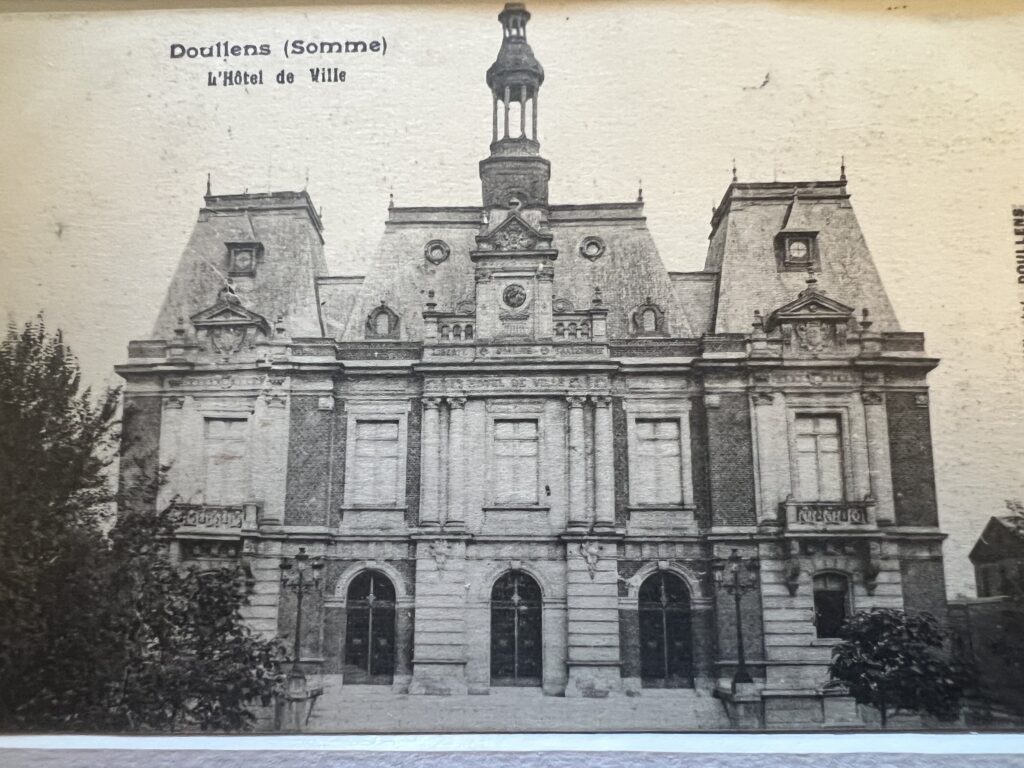
DOULLENS1: The mairie at Doullens just before the Great War (author’s collection)
Colonel Leo Amery, a member of the British secretariat at the SWC noted that Foch told Wilson he wanted to be the ‘co-ordinator’ of the Allied response to the crisis and for this to be agreed the following day.[65]
The location of the 26 March meeting switched from Dury, Byng’s Third Army HQ south of Amiens, to Doullens to its north to allow Haig to meet his army commanders before the Anglo-French conference began. He wrote to his wife Doris that he was ‘having an anxious time. All this trouble is due to making me take over more line last Winter and sending the 5 Divns to Italy which left me without adequate reserves. However we must go through with the business, and try and keep the war going. The French are very slow in coming to our support.[66] Sir William Robertson, kicking his heels in England having been forced out a few weeks earlier over the role and function of the EWB, commiserated with Haig on the ‘terrific load’ he had to carry: ‘Of course the whole trouble is caused by the want of men, as I have felt and said for months past would be the case, plus the everlasting interference by amateurs and the disturbance and loss of time involved by conferences, agreements, Versailles, etc, etc.’[67] Quite a contrast to Wilson’s unhelpful ‘I told you so’ of a day earlier.
*****
In some respects the events of 26 March were, by the time the participants had assembled in Doullens, an exercise in inevitability. The events of the previous five days had seen Haig and his generals resolute but desperate for assistance they felt was taking too long to arrive. Meanwhile, the French C-in-C Pétain believed he was doing all he could, as quickly as he could, but at the same time feared a major blow against his own forces to the south in Champagne. Ultimately it took politicians, acting with a resolution and directness which had been rare over the course of the war, to take the initiative and over-ride the mistrust which had hampered Anglo-French military relations. The lead was taken by Georges Clemenceau, the new French Prime Minister who, in his recent discussions with both Foch and Wilson, had already decided what must be done.
That morning, on their way to the meeting, Wilson told Milner that Foch had rejected his suggestion of Clemenceau taking on the role of ‘Generalissimo’. Foch feared, logically, that the Prime Minister would be pulled in one direction by him, and in another by Pétain and ‘there would be no unity of control’. Foch did not wish to command anything. ‘All he wanted was to have the express authority of the two Governments to bring about the maximum co-operation between the two Commanders-in-Chief.’ According to Wilson, Foch wanted a similar position to the one he had held during the First Battle of Ypres in October 1914: ‘When Field-Marshal Joffre delegated him to try and get the British and French to work more closely together–only he now wanted to be placed in that position with a more distinct and higher authorisation, that of both the Allied Governments.’ Milner agreed that it was the best solution ‘under the extremely urgent circumstances of the moment.’ British reserves had already been put in and the real question now was the strength of reserves the French would commit:
From what General Wilson had often told me, and from what I had seen myself the previous day, I was convinced that, whatever might be his other merits or demerits as a soldier, Foch possessed in a quite exceptional degree the promptitude, energy and resource necessary to get the most done in the time available, the whole question being evidently a race for time.[68]
Milner’s report suggests a confidence in Foch’s strong personality and its likely effect on the allied response, rather than a strictly military contribution. It also hints at a temporary intervention rather than a permanent one. In the first Milner was correct, but as we shall see, Foch’s future role was to be far from temporary.
Before the Allied delegations convened, Haig and Lawrence had a meeting with his army commanders, Horne (First Army), Plumer (Second Army), and Byng (Third Army). Sir Hubert Gough, whose Fifth Army was by this stage under French command, was not involved in the conference. Wilson and Milner passed Gough’s HQ at Dury on their way to Doullens ‘but we did not stop’.[69] The logic behind such a strange decision can only be that as far as the CIGS was concerned, Gough was no longer an officer of relevance in the British military hierarchy. Haig told his commanders that risks had to be taken by First and Second Armies if Third Army’s position again became critical: orders issued the previous day, that Amiens was to be covered and touch between the First and Third Armies maintained, held good and if heavily pressed, troops ‘must fight for every inch of ground.’[70] Once the Field Marshal had given his orders, Wilson and Milner joined the meeting. The latter told Haig that Clemenceau had just claimed that the British were about to fall back from Amiens: ‘As I quite expected, it turned out that the Field-Marshal’s view about Amiens had been misunderstood. He had no doubt in his mind as to the supreme importance of Amiens, nor any intention of abandoning it.’[71] Haig, it seems, was not ‘cowed’, after all and told Milner he had no reason to doubt the possibility of holding on providing the French brought all available troops as quickly as possible to cover the road to Amiens. Milner said that Clemenceau and Foch had both assured him that the French were ‘anxious to put everything in as quickly as possible.’[72] Milner and Wilson spoke privately to Haig who ‘agreed to my proposal for Foch to co-ordinate.’[73]
In the main meeting, chaired once more by Poincaré, the soldiers agreed unanimously that it was vital to retain control of Amiens. Pétain, echoing his caution of the day before, said he had already committed nine French divisions to the battle and 15 more were being brought up ‘as fast as possible’. Both Haig and Wilson were neither ‘happy or convinced’ by Pétain’s assurances and the latter ‘made an interjection which almost amounted to a protest’.[74] Foch, seemingly frustrated with his colleague’s apparent lack of urgency, ‘emphasised the necessity of instant action and impressing on all troops that they must give up no ground.’[75] Milner thought Pétain was ‘rather discouraging (perhaps rather more than he meant to be)’ about the pace of his divisions moving into place and ‘generally gave a certain impression of coldness and caution, as of a man playing for safety.’ Evidently Wilson, Haig and Foch were all dissatisfied with what was being said.[76] At this point Milner took Clemenceau aside and told him he was convinced that ‘Foch appeared to me to be the man who had the greatest grasp of the situation, and was most likely to deal with it with the intensest [sic] energy.’ The two politicians then spoke to their respective C-in-Cs and agreed on a form of words which gave Foch authority to ‘co-ordinate’ Anglo-French forces around Amiens. Foch had been clear that at this moment in the battle, protecting Amiens, not covering Paris as Pétain favoured, was the priority for Allied forces.
Haig’s suggestion that the wording be expanded to include all the ‘allied armies’(‘des armées alliées’) on the Western Front, was agreed, albeit somewhat prematurely.[77] According to Milner, ‘Poincaré, Clemenceau, and Loucheur were all delighted, and Haig, I was glad to see, also looked distinctly relieved and much happier than he had seemed earlier in the morning.’[78] Wilson noted that ‘Both Haig and I are delighted with this new arrangement about Foch. So is Foch and so, really, is Clemenceau who patted me on the head and said I was “un bon garçon”.’ Clemenceau, like most French actors the Great War drama, had long supported unity of command under a French Generalissimo and knew Wilson, while sceptical, was more open to the idea than Robertson ever could have been.[79] Later that afternoon Wilson and Milner called in on Haig at his headquarters in Montreuil and the Chief ‘told me he was greatly pleased with the arrangements.’[80] Milner thought Haig appeared to be ‘in much better spirits’ and, alluding to the Executive War Board he had managed to strangle at birth, ‘told me again that he felt sure the new arrangement would work, as he would have to do with “a man and not a committee”.’[81] As for the Field Marshal, he thought Foch ‘sound and sensible but Pétain had a terrible look. He had the appearance of a commander who was in a funk and has lost his nerve.’[82] Pétain had formed much the same view of Haig.
Foch set to work immediately, with two main aims, ensuring the British and French forces maintained contact, and defending Amiens. The following day, 27 March, Haig authorised him to give instructions to British army commanders.[83] While establishing a small staff, including the appointment of British liaison officers, Foch then began a ‘sustained campaign to have his powers increased.’[84] In the week after the conference at Doullens it became clear that Foch’s powers of persuasion were insufficient: he could ask, he could cajole, he could use his force of personality to try to get his way. He did all these things, but he could not give orders. It was not enough.[85] What Doullens had provided was a solution to an immediate crisis on that day, and it was fortunate that it coincided with the gradual slackening and slowing of the German attack and advance. It gave time for Foch to make his first initiatives. Had the German April Lys offensive not followed almost at once, Foch’s role might not have developed as it did. The difference between Foch and Pétain in the first few days after the first blow fell on the BEF is as much one of presentation as substance. By the day of the Doullens conference 21 French divisions had been moved by Pétain to the area of greatest weakness, with 11 more over the next two days.[86] There is merit in the British argument that these reinforcements might have arrived more quickly but arrive they did. Foch, once appointed co-ordinator, did not add additional forces to this mix, but his energy, decisive manner, and apparent empathy with the British was crucial.
While Foch was wrangling over his authority, the confusion with which the BEF in France reacted to OperationMichael was mirrored in London. Henry Wilson briefed Lloyd George, the King and then the War Cabinet, reassuring them all that, despite serous setbacks, ‘the chances were in our favour now.’[87] Anxious to verify Wilson and Milner’s assessments, Lloyd George sent Churchill to France to see Foch and provide ‘any form of assistance’.[88] This outraged both Wilson and Milner who, understandably, saw it as interference in their areas of responsibility. Wilson caught Churchill just before his train left Charing Cross: ‘He was being sent to Foch by LG! I told him I could not agree & I must have this changed & he must go to Clemenceau not to any soldier.’ The Prime Minister told Wilson, no doubt to mollify him, that he wanted Churchill to see Clemenceau because the British Ambassador Lord Bertie was ‘no use!’ Wilson speculated that Churchill would ‘advise L.G. to send Derby to Paris & put him (Winston) into the WO!’[89] Lloyd George subsequently instructed Churchill to ‘stick to Paris and not go directing strategy at GHQ’. Regardless, and entirely predictably, Churchill visited GHQ and was given a personal tour of the forward areas by Clemenceau. His reports to the British Prime Minister so upset Milner that he called on Wilson at his home:
At this morning’s Cabinet L.G. read out portions of 2 wires rec[eive]d from Winston…Milner referred to this and said he was going to tell L.G. that either he (M.) must have L.G.’s full confidence or he would have to leave the Govt. I agreed with Milner. This sending Winston over–first, with the idea of going to Foch which I killed, & then to Clemenceau is a direct snub to Milner who, after all, represented the Govt at Doullens & has, all along, been the Cabinet member at Versailles.[90]
Churchill had been urging a major French counter-offensive and reported that he was happy with their preparations.[91] Coming just a few days after a fundamental change in the mechanics of Anglo-French military control, such meddling was bound to lead to confusion. Wilson was as jealous as was Milner of Churchill’s access and anxious to get him back to London: ‘He is doing mischief in France.’[92] The next day the Prime Minister, at Churchill’s request and following ‘a serious misunderstanding’ between Foch, Haig and Rawlinson over troop deployment, set off for France with Wilson in tow.[93] Haig’s version of the events which precipitated Lloyd George’s journey is as calm and collected as Churchill’s is excitable. The British C-in-C wanted the French to assist him south of Villers-Bretonneux and called on Clemenceau for support. The latter phoned Foch who immediately agreed with Haig’s request.[94] When speed was of the essence, Haig having to go around Pétain to his political boss and for Clemenceau to then have to instruct Foch to instruct Pétain to agree to what Haig had requested in the first place was a recipe for disaster. ‘Serious misunderstanding’ or not, it illustrated the need for clarity around Foch’s position and authority. It would not be long in coming. The British Prime Minister and the CIGS arrived in France on the morning of 3 April and along with Haig met Clemenceau and Foch, plus the AEF generals Pershing and Bliss, at another French town hall, this time in Beauvais. Now Foch’s powers were increased to ‘strategic direction of military operations’ a remit which also included US forces.[95]
Much is made of Wilson’s relationship with Foch. It was long-standing and friendly, but contrary to claims by critics of Wilson he always put British interests first. On the morning of the Beauvais conference, Wilson told Lloyd George that ‘Clemenceau wanted Foch’s position strengthened. I agreed but not up to C-in-C especially as the Tiger wished this principally to allow Foch to coerce Pétain & not Haig who was working smoothly.’[96] A day earlier the War Cabinet discussed extending Foch’s powers to give him the right to issue ‘directions or orders, instead of being limited to co-ordination.’ Lloyd George had been in favour but stopped short of making Foch ‘C-in-C’. Wilson suggested that Foch probably did not need any additional powers and that it would be ‘inadvisable’ to change something that seemed to be working well.[97] David R. Woodward has argued that Wilson’s motivation in seeking to restrict Foch’s powers was ‘self advancement’ and a desire to ensure his friend did not become too powerful.[98] An alternative interpretation is that Wilson was still coming to terms with the impact of Foch’s new position. Despite his confidence in Foch, he had an abiding fear of French domination of Allied strategy, one which grew as Wilson’s relationship with Clemenceau came under the pressure of harsh reality.
Wilson claimed he opposed changing Foch’s remit because he wanted to avoid any opportunity for Haig and Pétain to wilfully ‘misunderstand’ the role. He argued incorrectly, unsuccessfully, and perhaps disingenuously, that the Doullens remit was stronger than the new proposal ‘but the Tiger & LG were in favour of the change…Lloyd George said [the] British public wanted Foch to have real power; did Doullens give this power?’[99] Wilson then drafted the agreement, including the right of either C-in-C to appeal to his government if he believed Foch’s orders endangered his army.[100] Haig, who was ‘in full agreement’ with the proposal, together with Wilson and Lloyd George all stressed the urgent need for a French offensive ‘as soon as possible’.[101] Foch agreed. If Wilson felt he had been defeated in his scheme of ‘self advancement’, at Foch’s expense, it was not reflected in his usually frank diary, the entry for this date concluding: ‘On the whole a satisfactory day.’ [102] Clemenceau suggested subsequently that Foch should also be made C-in-C of the Italian theatre:
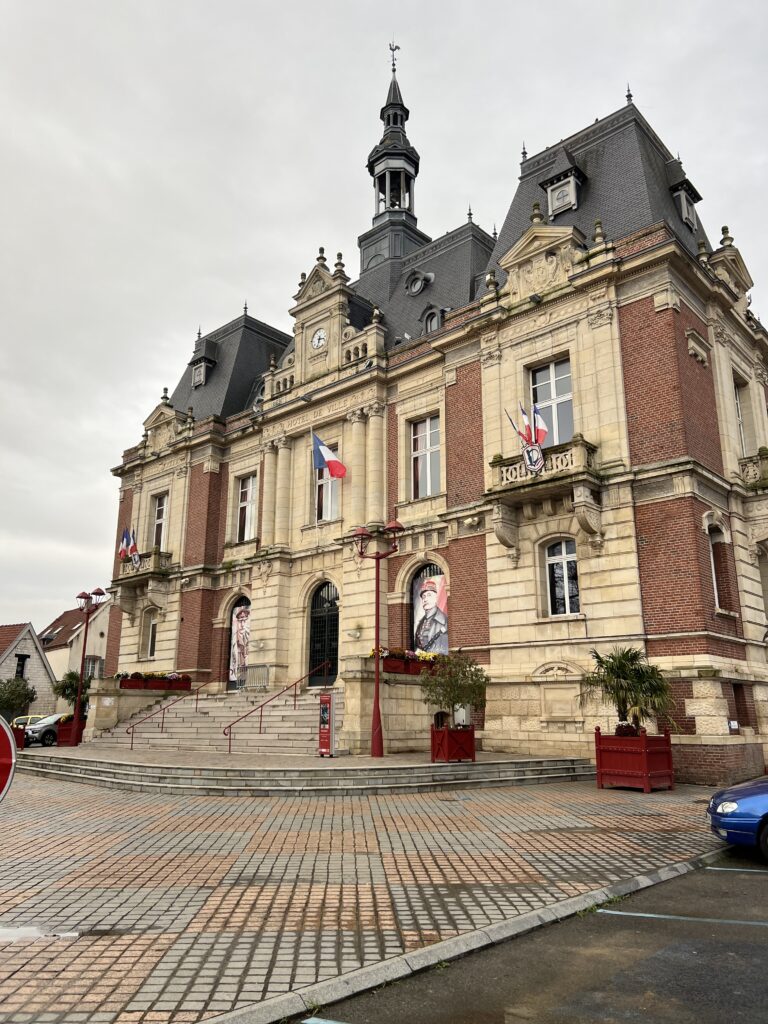
DOULLENS2: As it is today (John Spencer)
I am entirely opposed & said so strongly that the Cabinet agreed & wired saying that they did not agree. Foch is 67; he is not popular with the Italians; he has not got a Staff yet; he has not yet by any means got our front in hand, & in consequence I think he would be entirely overloaded.[103]
The War Cabinet’s diplomatic response was that they thought it ‘inadvisable’ to burden Foch with additional responsibilities and that a decision should be postponed.[104] In the days after Beauvais, and in response to Foch’s lobbying for a meaningful title, the Allies agonised over a form of words. The French leadership accepted that it needed to be one which gave him true authority but avoided offending the British. The latter acknowledged that only a French general could have overarching command in France, but by 1918 Britain’s dominating contribution to Allied the war effort meant tact was essential.[105] After much diplomatic toing and froing, on 14 April it was agreed that Foch would be ‘Général en chef des armées alliées’. It was not before time.
Despite his agreement at Beauvais, Foch failed to honour his promise of a French counter-offensive, nor would he agree to Haig’s plea for the French to relieve some of the British line, ideally north of the Somme, or in French Flanders, where another German attack was expected.[106] In a tacit acknowledgement of how the balance of power had shifted, Haig asked Wilson to intervene on the BEF’s behalf and the War Cabinet gave the latter ‘full powers to do what I thought best.’[107] The next day, 9 April, Haig and Lawrence told the CIGS they now favoured French support in Flanders. Wilson disagreed and wanted the French to relieve the British right in the Somme sector, but Haig said he was ‘afraid of French troops taking over our line in front of Amiens as he says they are fighting badly & would lose Amiens.’ Haig had concluded that ‘the French have neither enough troops nor stomach for a big attack …such as Foch was contemplating last Wed[nesday]’. While this discussion was taking place, news began to arrive of the start of the second major German offensive Operation Georgette, on a 25 mile front south from Ypres, in exactly the location the British had expected.[108] It is possible to have sympathy with both sides of this disagreement. Foch knew there was much more to come from the Germans but hoped the forces in place would be sufficient to bear the shock, leaving French and, ideally, American units to lead subsequent counter-attacks. From Haig’s perspective, his armies had been fighting for more than three weeks, he had been given no option other than to accept orders from a foreign general, and his own position remained precarious. On the way to the meeting in Beauvais Lloyd George told a reluctant Haig that Hubert Gough had to go following the rout of his Fifth Army. The following day, in one of his last official orders before himself being replaced, Derby formerly ordered Haig to relieve Gough of his command. [109] As for Henry Wilson, he was made rudely aware of the limits of his friendship with the new Allied supreme commander. In Haig’s support he spent two fruitless hours with Foch. The Generalissimo ‘simply would not hear’ of moving troops to Flanders, nor to supporting the defence of Amiens. All Wilson got was a commitment to put French reserves astride the Somme for deployment further north if required. His mission having failed, all he could do was urge Haig, who was worried that the movement of French forces would hinder his own, to register a note of protest, as agreed in the Doullens protocol.[110] The British C-in-C castigated Foch and complained that Wilson ‘did not help us at all in our negotiations…His sympathies almost seem to be with the French.’[111] Old suspicions were hard to break. Wilson had already sensed the way the wind was blowing; control over Britain’s armies had shifted but Haig did ‘not in the least understand the situation yet’. [112] Another outcome of these discussions was that Foch was persuaded, despite his initial objections, to accept Lieutenant General Sir John Du Cane as principal liaison officer between himself and Haig.[113] Two days later, in a message aimed at his Ally as much as his own troops, Haig issued his famous ‘Backs to the Wall’ order of the day.[114] The Georgette offensive threatened the Channel ports creating, Wilson told the War Cabinet, a ‘desperately serious’ state of affairs.[115] He supported Haig’s demand for French reinforcements for Plumer’s Second Army, and accompanied Milner to Paris to negotiate directly with the French Prime minister.[116] Milner and Haig met Foch at Abbeville on 14 April where the British C-in-C thought the Frenchman ‘unmethodical’ and prone to short-termism.[117] Two days later Foch ‘brushed aside’ British concerns and criticised their tactics as ‘not good’. Wilson pressed Foch to flood the countryside south of Dunkirk to impede any German advance, allowing the BEF to shorten its line, but the meeting ended indecisively.[118] In the event the British line, although pushed back, held.[119] What is clear from these clashes is that Foch was now firmly in control of Allied strategy. He had Clemenceau’s support, and Lloyd George seemed content that British strategic authority had moved away from Haig. Interestingly, considering the oft-repeated criticism of Wilson’s ‘Francophilia’ it was the British CIGS who appeared the strongest critic of the new relationship: ‘The attitude of Foch & the Tiger was difficult & it is clear to me that we must assert ourselves more.’[120]
Over time the new co-operative approach to allied command bedded in, with Pétain suffering more bruising encounters with the new Generalissimo than Haig.[121] Clemenceau was actively involved in oiling the wheels of the new mechanism, with Milner making frequent visits to France to confer with ‘the Tiger’. In July, fears that Foch was risking the British front in order to defend Paris so concerned Lloyd George that he protested directly to Clemenceau, pointing out that General Foch was an Allied and not merely a French Commander-in-Chief, and that he must treat the Allied interests as a whole, making his dispositions on its basis and not mainly from the point of view of French interests.’[122] Despite the disagreements unity of command held on the Western Front, and played a significant role in the Allied victory. A concept long opposed by the British, both politicians and soldiers, only came to pass when the threat of defeat was so great that there appeared to be no alternative. Responsibility for the ultimate acceptance of unified control must go to the politicians, especially Clemenceau and Milner who both accepted its logic, with Wilson and Foch understanding the need for compromise and diplomacy. Haig deployed his usual pragmatism and acknowledged that desperate times demanded desperate measures:
I knew Foch’s strategical ideas were in conformity with the orders given me by Lord Kitchener when I became C-in-C, and that he was a man of great courage and decision as shown during the fighting at Ypres in October and November 1914.[123]
The ends justified the means.
* Dr John Spencer FRHistS, is the Douglas Haig Fellow 2025 and presented an outline of this paper at the annual lunch in June. The current version is included in Turning the Tide: The British Army on the Western Front 1918, (Helion & Company) edited by Spencer Jones and due for publication in early 2026. The author is grateful to John Hussey OBE for his comments and contribution to this work.
[1] For a discussion of the creation of the creation of the ‘Executive War Board’ and its ramifications see John Spencer ‘Decline and Fall: Sir William Robertson as Chief of the Imperial General Staff in 1918’ in Spencer Jones (ed.), The Darkest Year: The British Army on the Western Front 1917 (Warwick: Helion & Company, 2022), pp. 70–71.
[2] The British War Cabinet confirmed its agreement to Foch’s title on 11 April 1918, The National Archives of Great Britain (hereafter TNA) CAB 23/14/10; David R. Woodward, Trial by Friendship: Anglo-American Relations 1917–1918 (Lexington: University of Kentucky Press, 1993), p. 159..
[3] William Philpott, ‘Squaring the Circle: The Higher Co-ordination of the Entente in the winter of 1915-16’, English Historical Review, Vol. 114, No. 458 (1999), pp. 875–898.
[4] See S.R. Williamson Jr, The Politics of Grand Strategy: Britain and France Prepare for War 1904-1914 (Cambridge, Mass.: Harvard University Press, 1969), pp. 342–6.
[5] James E. Edmonds, Official History of the Great War Based on Official Documents: Military Operations in France and Belgium, 1914, (London: MacMillan, 1937 [1922]), Vol. I, Appendix 8, pp. 499.
[6] Roy A. Prete, Strategy and Command: The Anglo-French Coalition on the Western Front 1914 (London: McGill-Queen’s University Press, 2009), p. 70.
[7] Lord Esher, journal entry 20 March 1915, in Oliver, Viscount Esher, (ed.), Journals and Letters of Reginald, Viscount Esher, (Vol. 3), 191 –1915, (London: Ivor Nicholson & Watson, 1938), p.223.
[8] Esher, Journals and Letters, Esher to Sir John French, 3 April 1915, p. 226.
[9] Elizabeth Greenhalgh, Victory through Coalition: Britain and France during the First World War (Cambridge: Cambridge University Press, 2008 [2005]), p. 23; see also Hew Strachan, The First World War: Vol. 1: To Arms (Oxford: Oxford University Press, 2002 [2001]), pp. 275–80.
[10] Henry Wilson diary, 16 October 1914, IWM, Wilson Papers, HHW 1/23 [hereafter Wilson diary].
[11] Keith Jeffery, Field Marshal Sir Henry Wilson: A Political Soldier (Oxford: Oxford University Press, 2008 [2006]) p. 145.
[12] Strachan, To Arms, p. 269.
[13] Wilson, letter, 2 November 1914, in C.E. Callwell, Field-Marshal Sir Henry Wilson, Bart., G.C.B., D.S.O., His Life and Diaries, (two vols.), London: Cassell 1927) Vol. 1, p. 186.
[14] Elizabeth Greenhalgh, Foch in Command: The Forging of a First World War General (Cambridge: Cambridge University Press, 2011), pp. 51–55.
[15] John Spencer, Wilson’s War: Sir Henry Wilson’s Influence on British Military Policy in the Great War and its Aftermath (Warwick: Helion & Company, 2020), pp. 48–56.
[16] Nick Lloyd, Loos 1915 (Stroud: The History Press, 2008 [2006]), p. 190.
[17] Robertson to Lord Stamfordham, 1 October 1915, Robertson papers, (7/1/18), Liddle Hart Centre for Military Archives (LHCMA).
[18]Greenhalgh, Victory, pp. 71, 75.
[19] Colonel C. à Court Repington, The First World War 1914–1918 (London: Constable, 1920), Vol. II, pp. 487–9.
[20] David R. Woodward, Lloyd George and the Generals (Newark: University of Delaware Press, 1983), pp. 144-156.
[21]TNA CAB 27/8, WP 61, ‘Present State of the War, future prospects and future action to be taken,’ General Sir Henry Wilson to War Cabinet, 20 October 1917 (hereafter CAB 27/8, WP 61).
[22] William Philpott, Attrition: Fighting the First World War (London: Little, Brown, 2014), p. 311.
[23] J.M. Bourne, Who’s Who in World War I (London: Routledge, 2001), p. 176
[24] For details of the various abortive attempts to establish a coherent manpower policy before autumn 1917 see R.J.Q. Adams, and Philip P. Poirier, The Conscription Controversy in Britain, 1900-1918 (Columbus: Ohio State University Press, 1987), and Keith Grieves, The Politics of Manpower (Manchester: Manchester University Press, 1988).
[25] Adams and Poirier, Conscription Controversy, p. 213.
[26]TNA CAB 24/28/95, ‘Recruiting Position: the Problem and Prospect’, Memorandum to the War Cabinet by the Minister of National Service, 13 October 1917.
[27] Haig’s paper can be located at TNA CAB 27/8, GT 2243, Haig to Robertson, 8 October 1917, hereafter CAB 27/8, GT 2243) and Robertson’s at TNA CAB 24/28/42, GT 2242, ‘Future Military Policy’, and ‘Occupation of Jaffa-Jerusalem Line’, CIGS to War Cabinet, 9 October 1917.
[28] TNA CAB 24/30/36, ‘Munitions Possibilities of 1918’, memorandum to the War Cabinet, 21 October 1918.
[29] TNA CAB 24/34/66, War Cabinet, ‘Casualties in the Expeditionary Forces, 1 January to November 1917’. In fact, the BEF suffered 759,000 casualties (killed, missing, wounded and prisoners) in 1917, Statistics of the Military Effort of the British Empire during the Great War 1914-1920 (London: HMSO, 1922), p. 361.
[30] CAB 24/4/67, War Cabinet minutes, 6 December 1917; pp. 348-9.
[31] David French, The Strategy of the Lloyd George Coalition: 1916–18 (Oxford: Clarendon Press, 2002 {1995]), p. 185.
[32] TNA CAB 24/4/36, ‘Final Revise of the Draft Report on Man-Power’, 1 March 1918, with covering note by Hankey, 2 April 1918; (the initial draft report was completed on 9 January 1918); minutes of the meetings of the Cabinet Committee on Man-Power are at TNA CAB 27/14; see also Simon Justice, ‘Vanishing Battalions: The Nature, Impact and Implications of British Infantry Reorganization prior to the German Spring Offensives of 1918’, in Michael LoCicero, Ross Mahoney, Ross, & Stuart Mitchell, (eds.), A Military Transformed?: Adaptation and Innovation in the British Military, 1792-1945 (Solihull: Helion, 2014), pp. 157-173.
[33] David R. Woodward, ‘Did Lloyd George Starve the British Army of Men Prior to the German Offensive of 21 March 1918?’, The Historical Journal, Vol. 27, No. 1 (March, 1984), pp. 241–252.
[34] Spencer, Wilson’s War, pp. 147–152.
[35] James E. Edmonds, Official History of the Great War Based on Official Documents: Military Operations in France and Belgium, 1918, (London: MacMillan, 1935), Vol. I, pp. 114–5; David T. Zabecki, The German 1918 Offensives: A Case Study in the Operational Level of War (Abingdon: Routledge 2009 [2006]), pp. 134–138; Jonathan Boff, Haig’s Enemy: Crown Prince Rupprecht and Germany’s War on the Western Front (Oxford: Oxford University Press, 2018), p. 210.
[36] Herbert Lawrence became CGS to the BEF on 22 January 1918.
[37] TNA OAD.291/32, Army Commanders’ Conference, ‘The Present Situation on the Western Front, presented to the Conference, signed H. Lawrence, Lt-Gen, CGS’.
[38] Maurice diary, 4 March 1918, in Nancy Maurice (ed.), The Maurice Case: From the Papers of Major-General Sir Frederick Maurice (London: Leo Cooper, 1972), p. 74.
[39] John Hussey, ‘Between Somme and Ancre: 35th Division’s Troubles, 26 March 1918’, British Army Review, 118, (1998), pp. 76–86.
[40] National Library of Scotland (hereafter NLS), Haig to wife, Haig papers, 21 March 1918, Acc 3155/15.
[41] NKS, Haig manuscript diary, 21 March 1918, Acc 3155/97 and 375.
[42] TNA CAB 23/5/61, War Cabinet, 21 March 1918.
[43] Maurice diary, 21 March 1918, Maurice Case, p. 76.
[44] TNA CAB 23/5/62, War Cabinet, 22 March 1918.
[45] IWM Wilson diary, 22 March 1918.
[46] TNA WO.158/43, General Davison to General Clive (handwritten note of telephone message, 22 March 1918.
[47] IWM, Wilson diary, 13 March 1918; NLS, Haig (manuscript) diary, 13 March 1918.
[48] NLS, Haig papers, Acc 3155/97 and 375, Haig diary, 23 March 1918.
[49] TNA WO.158/72, ‘Record of a Conference held at the Commander-in-Chief’s House at 7 pm on 23 March 1918’, OAD.785.
[50] TNA WO.33/920, European War Secret Telegrams: Series A, France, vol. 5, (2 July 1917–3 May 1918), No.7716, p.407, Adjutant General, WO to Adjutant General, BEF, 23 March 1918.
[51] Maurice diary 23 March 1918, Maurice Case, p. 77.
[52] Colonel Herbillon, Souvenirs d’un officier de liaison pendant la Guerre Monidale: du general en chef de government, 2 vols (Paris: Tallandier, 1930), II: p. 228.
[53] David Lloyd George, War Memoirs of David Lloyd George, 2 Vols., (London: Odhams, 1938), Volume II, pp. 1730-31.
[54] ‘Milner’s Memorandum on Doullens’ (27 March 1918), Viscount. Milner papers, Bodleian Library, Oxford, box 46, fols 17-27 [hereafter Milner Memorandum]. The document also appears in the War Cabinet papers as ‘Memorandum by Lord Milner on his visit to France, including the conference at Doullens, March 26, 1918’, signed by Milner, 27 March 1918, TNA CAB 28/3, IC53.
[55] Wilson diary, 24 March 1918.
[56]TNA WO 33/920, FMC-in-C telegram to CIGS, OBC 786, No.7734, p.411.
[57] Elizabeth Greenhalgh, ‘Myth and Memory: Sir Douglas Haig and the Imposition of Unified Command in March 1918,’ Journal of Military History, Vol. 68, (2004), pp. 771-820; Gary Sheffield, The Chief: Douglas Haig and the British Army, (London: Aurum, 2011), pp. 274-5
[58] Haig diary, 25 March 1918, in Gary Sheffield and John Bourne, Douglas Haig: War Diaries and Letters 1914–1918 (London: Phoenix, 2006 [2005]), pp. 392-393.
[59] Greenhalgh, Victory, pp. 196-7; the issue is examined in greater detail in idem., ‘Myth and Memory: Sir Douglas Haig and the Imposition of Allied Command in March 1918’, Journal of Military History 68:2 (July 2004), pp. 771–820.
[60] Sheffield, The Chief, p. 275.
[61] Milner Memorandum, ref. 25 March 1918; Rawlinson had succeeded Sir Henry Wilson as the British government’s Permanent Military Representative to the SWC on the latter’s appointment as CIGS on 18 February 1918.
[62] Milner Memorandum, ref. 25 March 1918.
[63] Wilson diary, 25 March 1918.
[64] Milner Memorandum, ref. 25 March 1918.
[65] John Barnes and David Nicholson (eds.), The Leo Amery Diaries, Volume One: 1896–1929, (London: Hutchinson, 1980), pp. 210–11.
[66] Haig letter to wife Tuesday morning, 26 March 1918 Haig papers, NLS Acc.3155/124.
[67] NLS, Robertson to Haig, Haig papers, Acc.3155/124.
[68] Milner Memorandum, ref. 26 March 1918.
[69] Wilson diary 26 March 1918; Milner Memorandum, ref. 26 March 1918.
[70]TNA, WO.158/72, OAD. 793, First British Conference, GHQ, 11am 26 March 1918.
[71] Milner Memorandum, ref. 26 March 1918.
[72] TNA, WO.158/72, OAD. 794, Second British Conference, Doullens, 11.40am 26 March 1918.
[73] Wilson diary, 26 March 1918.
[74] Milner Memorandum, ref. 26 March 1918.
[75] TNA, WO.158/72, WO.158/72, Third Conference, Doullens, 12 noon 26 March 1918.
[76] Milner Memorandum, ref. 26 March 1918.
[77] Greenhalgh, Victory, pp. 194–5.
[78] Milner Memorandum, ref. 26 March 1918.
[79] David S. Newhall, Clemenceau at War, (Lewiston, NY: Edwin Mellen Press, 1991), p. 392; Woodward, Lloyd George, pp. 255-6.
[80] Wilson diary, 26 March 1918
[81] Milner Memorandum.
[82] Haig diary (transcript version), 26 March 1918, in Sheffield & Bourne, Haig Diary, p. 394.
[83] Greenhalgh, Foch, p. 307.
[84] Greenhalgh, Victory, p. 198.
[85] Greenhalgh, Foch, p. 309.
[86] Greenhalgh, Victory, p. 193.
[87] Wilson diary, 27 March 1918; TNA CAB 23/5/66, War Cabinet, 27 March 1918.
[88] Martin Gilbert, Winston S. Churchill: 1917-22 (Volume IV) (London: Heinemann, 1975), p. 84.
[89] Wilson diary, 28 March 1918 (original emphasis).
[90] Wilson diary, 30 March 1918; BLO, Milner diary, 29 and 30 March 1918.
[91]Hankey diary 29 March 1918, Lord Hankey, Lord, The Supreme Command, (2 vols.), (London: George Allen & Unwin, 1961), (Vol. II), p. 789.
[92] Wilson diary, 2 April 1918.
[93] Martin Gilbert, Winston S. Churchill: Volume IV, 1917-22, p. 102; TNA, CAB 23/6/2, War Cabinet, 2 April 1918.
[94] Haig diary, 1 April 1918, Sheffield & Bourne, Haig Diary, pp. 396-7.
[95] Greenhalgh, Victory, p. 200; Wilson Diary, 3 April 1918.
[96] Wilson diary, 3 April 1918.
[97] TNA, CAB 23/6/2, War Cabinet, 2 April 1918.
[98] Woodward, Lloyd George, p. 289.
[99] Wilson diary, 3 April 1918.
[100] Hankey, Supreme Command, (vol. II), pp. 791-2; the full text of the Beauvais Agreement appears as an appendix to TNA, CAB 23/6/4, War Cabinet, 4 April 1918.
[101] Haig diary, (original emphasis), 3 April 1918, Sheffield & Bourne, Haig Diary, p. 397.
[102] Wilson diary, 3 April 1918; TNA, CAB 28/3, War Cabinet, IC (Allied Conferences), Volume III, IC 55 (a), Procès-verbal of a Conference at Beauvais, 3 April 1918.
[103] Wilson diary, 5 April 1918.
[104] TNA, CAB 23/6/11, War Cabinet minutes, 5 April 1918.
[105] Greenhalgh, Victory, pp. 201-2.
[106] J.P. Harris, Douglas Haig and the First World War (Cambridge: Cambridge University Press, 2008), p. 466-7.
[107] Haig diary, 7 April 1918, Sheffield & Bourne, Haig Diary, pp. 398-399; Wilson diary, 8 April 1918.
[108] Wilson diary and Haig (manuscript) diary, 9 April 1918; Zabecki, German Offensives, pp. 186-7.
[109] Wilson diary, 4 April 1918; Haig diary, 4 April 1918, Sheffield & Bourne, Haig Diary. A fortnight later Derby was shuffled off to Paris to replace the ailing ambassador Lord Bertie, while Lloyd George’s ally Milner became Secretary of State for War.
[110] Wilson diary, 9 April 1918.
[111] NLS, Haig (manuscript) diary, 9 April 1918.
[112] Wilson diary, 6 April 1918; Greenhalgh, Victory, p. 203; Harris, Haig, p. 470.
[113] Wilson diary, 9 April and Haig (manuscript diary, 9 April 1918); see also Elizabeth Greenhalgh (ed.), Lieutenant General Sir John Du Cane, KCB, With Marshal Foch: A British General at Allied Supreme Headquarters April-November 1918(Solihull: Helion, 2108), p. xiv, and passim.
[114] James E. Edmonds, Official History of the Great War Based on Official Documents: Military Operations in France and Belgium, 1918, (London: MacMillan, 1937), Vol. II, Appendix 10, p. 512
[115] Wilson diary, 12 April 1918; TNA CAB 23/6/12, War Cabinet, 12 April 1918.
[116] Wilson diary, 13 and 15 April 1918.
[117] Haig diary, 14 April 1918, Sheffield and Bourne, Haig Dairy, p. 404; ‘Conference at Abbeville’, TNA WO 158/72/25.
[118] Wilson diary, 16 April 1918; Greenhalgh, Foch, pp. 315-6.
[119] Zabecki, German Offensives, pp. 204-5.
[120] Wilson diary, 27 April 1918.
[121] Greenhalgh, Victory, pp. 209, 222 and passim.
[122] TNA CAB 23/14/26 WC 444a, War Cabinet, 11 July 1918 (original emphasis).
[123] Wilson (typescript) diary, 25 March 1918, Sheffield and Bourne, Haig Diary, p. 393.
This essay appeared in the 2024 issue of DHF Records
Is it any Wonder…?
Haig, French, and the 21st Division at Loos
September 1915.
Derek Clayton
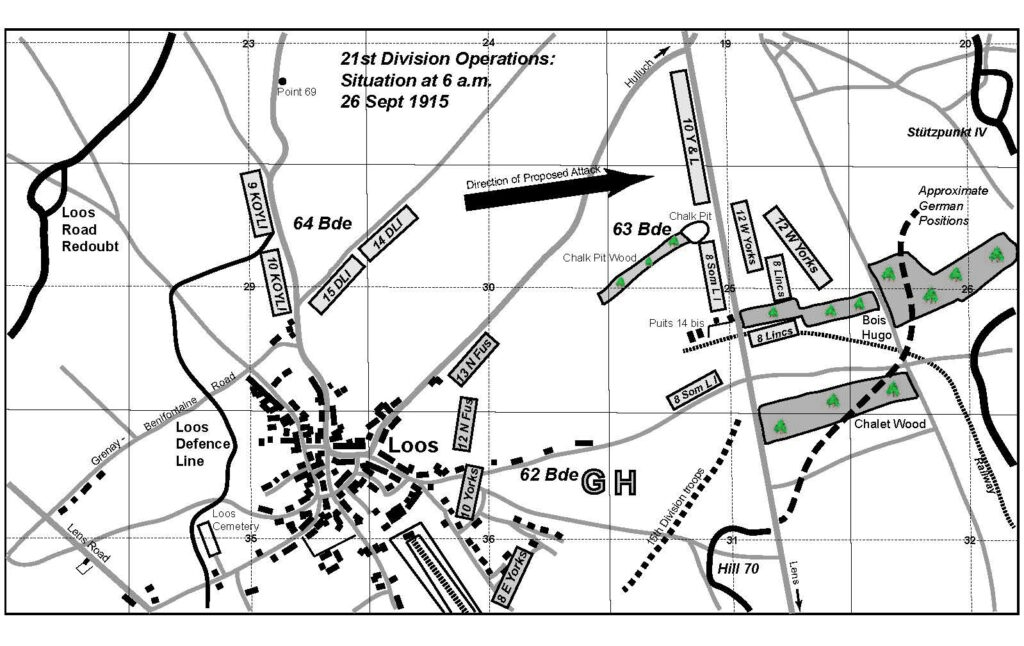
Writing to James Edmonds, the official historian, in January 1926, with regard to Sir John French, Sir Douglas Haig, and their dispute over the use of the reserves at the Battle of Loos, Major-General A.A. Montgomery, who was on the General Staff of IV Corps at the time, summed up his thoughts by stating: “two people can’t run a battle each on his own lines. […] What a loss of life the obstinacy of the two men caused”.[1]
The performance of the reserve divisions has been a topic of controversy and argument ever since they were thrown into action on the second day of the battle with absolutely no prior battlefield experience, condemned to a brutal baptism of fire. Nick Lloyd, in his recent book, suggests that their exploits have been veiled in “myth and misunderstanding”.[2] Edmonds is of the opinion that they were asked to perform a “nearly impossible task”.[3]
It is still widely believed, however, that the two divisions (21st and 24th) advanced against the second German defensive line on 26 September and were routed by machine gun fire. This is far too simplistic. This essay, concentrating on 21st Division, will show that the true picture is much more complicated and far less damning of the divisions’ performance.
The plans for the assault originated from General Joffre and the French General Staff. On paper they appear attractive, if frighteningly ambitious. With the Germans occupying a huge salient in northern France – its farthest south-westerly point being only sixty miles from Paris – it was proposed that a pincer attack on the southern and western flanks, (the latter involving the BEF), would render it untenable. It would require advances measured in dozens of miles.[4]
Sir John French was initially keen to participate, believing that the Allies should “strike as soon as possible”.[5] GHQ received a draft scheme from the French Commander-in-Chief on 4 June. The BEF would be required, after taking over twenty-two miles of the French line south of Arras, to launch a full-scale attack in conjunction with the French Tenth Army, either north of Lens or just south of Arras. Two weeks later, Sir John told General Foch (commanding the Groupe d’ Armées du Nord) that he intended to attack north of Lens, with “units of First Army re-arranged to ensure that the British offensive would be delivered by the best troops”.[6] The following day, he asked the commander of First Army, Sir Douglas Haig, to submit a detailed report on the feasibility of an attack at that location.
Haig made a personal reconnaissance of the area, speaking with the commanders already in the field. On 20 June, he motored to the Bois de Bouvigny, from where he “got a very good view of the country towards Loos, and the two lines of defence”.[7]
The terrain, largely flat and dotted with coal pits and mining villages, led Haig to state that: “This all renders the problem of an attack in this area very difficult”.[8] Indeed, his diary entry of two days later concludes that “an advance in the open, except by night, is impossible”.[9] On 23 June, Haig submitted his report. Its five pages did not make re-assuring reading. Extensive quotation is enlightening. The German front line itself would be a challenge, being sited
“immediately in front of the crest of the ridge, while the supporting trench is just behind it. Both trenches are wired. It is believed to be impossible to bring observed artillery fire to bear on the second line, or to cut the wire in front of it from our current position: and it is doubtful if observation stations could be got for the purpose even if we occupy the German front line trenches”.[10]
Haig’s continued assessment of the German support line is even more pessimistic.
“Any attack on the southern part of this second line [the very part of the line that 21st Division was later ordered to attack] is enfiladed from the SPOIL BANK running south-east from FOSSE No.5, which is itself a sort of natural fortress. The Germans have, nearly everywhere south of the canal, the advantage of artillery observation stations and can concentrate the fire of their guns from VIOLAINES to LENS on any force which we may collect for attack in this area. The country between Loos and Fosse No. 8 is also flat and open, consequently much difficulty is likely to be experienced in supporting an attack on the German trenches, and in sending up supplies and reinforcements to the troops when the German front line of trenches has been captured. The villages in the rear of the German line are strongly defended, and the ground between them is flat and open, so that a further advance eastward would be extremely difficult”.[11]
Haig did think that limited attacks to capture the Hohenzollern Redoubt and the front line trench in front of the town of Loos might be practicable, but assaults elsewhere were “not recommended”.[12] According to Nick Lloyd, Haig’s report was “a model of clarity and sound military reasoning”, adding that “later events would prove it mostly correct”.[13] Two days later, Haig submitted a subsidiary report, but he had not changed his mind, affirming that “this area is not favourable for an attack”.[14] He goes on, at some length, to suggest that another attack at Aubers Ridge would be his preferred option.
Sir John French was clearly worried by this report, and his state of mind would not have been improved by the conclusions arrived at during the Allied Munitions Conference held in Boulogne (19 – 20 June):
“For an offensive on the Western Front to have a reasonable chance of success, it would have to be delivered on a front of twenty-five miles by over thirty divisions and supported by 1,150 heavy guns and howitzers and the normal complement of field artillery. […] This quantity of guns and necessary ammunition could not be produced before the spring of 1916”.[15]
Perhaps not totally convinced by Haig’s report, Sir John decided to go and see the lie of the land at Loos for himself. Staring down from Notre Dame de Lorette on 12 July, he “decided that Haig was right”.[16] A crisis of confidence at GHQ was the predictable outcome. With Haig still insisting that the idea of an attack south of the La Bassée Canal should be abandoned, Sir John French arranged a conference with General Foch, which took place at Frévent on 27 July. Here, French tried to wriggle out of his previously-made commitment, suggesting assaults on Aubers Ridge and even as far away as the Wytschaete-Messines Ridge in Belgium. Foch would not be moved, however, and insisted that, in order to be of any use in the overall scheme, the BEF must attack alongside the French Tenth Army, that is, south of the La Bassée Canal, on the Loos – Hulluch front.
Further wrangling came to nothing, and on 10 August, French reluctantly agreed to the location for the BEF assault insisted upon by Foch and Joffre. French had, however, rather disingenuously, decided to downscale drastically the level of British involvement. He had already informed Sir Douglas Haig of his revised plan at a conference in St Omer where they, along with Sir William Robertson, had discussed Joffre’s plan. Sir Douglas wrote in his diary on 7 August:
“Sir John has decided to comply with General Joffre’s wishes, […] but my attack is to be made chiefly with artillery and I am not to launch a large force of infantry to the attack of objectives which are so strongly held as to be liable to result only in the sacrifice of many lives. That is to say, I am to assist the French by neutralising the Enemy’s artillery and by holding the hostile infantry on my front”.[17]
When Sir John French wrote to Joffre agreeing to the attack south of the canal, but proposing an artillery-only action, and waiting until the German positions south of Lens had been outflanked by the French advance before committing any infantry, the latter was not impressed. With both parties unwilling to back down, the matter had to be resolved at the political level, involving the French Minister for War, Millebrand, and his British counterpart, Lord Kitchener. Kitchener met with Millebrand and Joffre on 16 August, and, swayed by the unfavourable situations on both the Russian and Italian fronts, and with the Gallipoli campaign going badly, he reluctantly agreed that the proposed offensive in the west would have to be fully and energetically supported, in order to “avoid an open break with the French”.[18] He decided that “we must act with all energy and do our utmost to help France in their offensive, even though by doing so we may suffer very heavy losses”,[19] and informed Sir John French of his decision, confirming this by telegram on the 21st, telling him to “take the offensive and act vigorously”.
French and Haig were thus compelled, against their better judgement, to “undertake operations before [they were] ready, over ground that was most unfavourable, […] and with no more than a quarter of the troops [..] considered necessary for a successful attack”.[20] They would have to make the best of a bad situation. Sir John French was also at this point concerned that plots were afoot to replace him as Commander-in-Chief. He wrote to Mrs Winifred Bennett, his mistress, bemoaning that “Whatever may happen I shall have to bear the brunt of it and in cricket language they ‘may change the bowler’ ”.[21]
The decision made, it fell to Haig to plan for the battle. Whether he then succumbed to an acute attack of optimism or whether he simply accepted the fact that he would have to do as he was ordered and got on with it, is a matter for debate.[22] Richard Holmes accuses GHQ and First Army of going through “a curious process of self-deception”.[23] Whatever the truth, by the time Haig addressed his corps and divisional commanders on 6 September, he seemed hopeful that a six-division attack by IV and I Corps south of the canal might lead to a decisive breakthrough. To some extent, this judgement hinged on two factors: first, the use, in the initial stages of the assault, of chlorine gas; second, the timely introduction of reserves to attack and rupture the German second line.
Haig put great store by the hoped-for efficacy of gas. It was to be delivered from the front line trenches from cylinders for a period of forty minutes immediately before ‘Zero’. It had been calculated that the German primitive padded respirators were only good for fifteen minutes before they had to be re-dipped in the anti-gas solution, and that the breathing apparatus issued to some of their machine gunners could only sustain them for half an hour. As early as 26 August, however, Haig was informed that problems with the production of the chlorine gas cylinders meant that the required number could not be supplied in time. It is indicative of Haig’s growing obsession that gas was going to be a deciding factor in the attack that as late as 16 September he was writing to Robertson, asking him
“to send a special officer to London to (a) insist on gas factories working night and day – at present they only work 8 hours daily – and (b) make special arrangements to get the gas brought out and sent up to the troops. The situation was entirely a special one and special measures must be taken to ensure success”.[24]
In the end, 5,028 cylinders were supplied – just over half of the number required. This meant that the gas attack had to be supplemented by smoke candles: twelve minutes of gas, followed by eight of smoke, twelve more of gas and a final eight minutes of smoke.
It is the second factor – the use of the reserves – that has proven to be the most controversial aspect of the Battle of Loos. The reserve force, XI Corps, was made up of the newly-formed Guards Division, and the ‘New Army’ 21st[25] and 24th Divisions. (The Cavalry Corps was also there to follow up any breakthrough that might occur.) Why were two raw, untried divisions chosen to form part of the reserve? Edmonds offers two reasons: with First and Second Armies having had four experienced divisions already taken from them to help form Third Army, and with the BEF extending its line to take over the French line north of the Somme, “it was considered that not another seasoned division could be withdrawn without endangering the British front”.[26] He also suggests that French was quite happy to employ “young troops”, given that they would be more keen in the attack than those who “had acquired the sedentary habits of trench warfare”.[27] Keen they may have been, but having only been formed under command of Lieutenant-General R.C.B. Haking on 30 August 1915,[28] they were operating with a new staff, “composed of officers who had never previously worked together or served on a corps staff”.[29] As will be seen, even moving the formations forward efficiently onto the battlefield would prove beyond them. In addition, four of the six ‘New Army’ brigade commanders were ‘dug out’ retired officers, as were twenty-five of the twenty-six battalion commanders. The vast majority of the other officers were newly-commissioned.[30]
Haig and French were at odds regarding the use of the reserves from the outset, and the problem was never satisfactorily resolved. French was favouring an attack at Loos where the reserves were to be employed “once success had been achieved”:[31] indeed, Major-General Forestier-Walker, commanding 21st Division, had been assured by Sir William Robertson that “under no conceivable circumstances would the 21st or 24th Division be put in unless, and until, the Germans were absolutely smashed and retiring in disorder”.[32] Haig’s plan, however, required the reserves to be used to “ensure this initial success”.[33] This divergence of purpose caused an ongoing dispute between the two commanders regarding the placement of the reserve force. French intended to deploy the reserve some 20,000 yards from the front line near the town of Lillers. This infuriated Haig, who wrote to his Commander-in-Chief demanding that the nearest units of XI Corps be placed close to Noeux-les-Mines – only 5,000 yards from the battlefield – stating that “the whole plan of First Army is based on the assumption that the troops in the General Reserve will be close at hand”.[34] French, initially, would not budge.
A second, and possibly more important, problem was that French intended to keep the reserves under his personal control until he saw fit to release them to First Army command. It has been suggested that Sir John feared Haig might push the reserves forward under unfavourable circumstances.[35] Haig believed, however, that if the reserves were to be of any use at all, their timely deployment would prove the decisive factor. The disagreement rumbled on, and with French indisposed for much of the time immediately before the battle by illness,[36] Haig sought to lobby both Robertson and Foch in an attempt to resolve the problem. In the end, he achieved a partial victory: the reserves would be at Noeux-les-Mines on the morning of 25 September, as he had wished, but they would still remain firmly under GHQ control until Sir John gave orders to the contrary.
Given these circumstances, it would have been useful if French and Haig had been able to speak with each other directly on the morning of 25 September. They were not. On the eve of the battle, French left his HQ at St Omer, which had secure telephone lines to each Army HQ, and took a skeleton staff to a chateau near Philomel, three miles south of Lillers, which did not. Any communication with Haig would therefore be delayed by having to be relayed via St Omer.
On that same evening, 21st and 24th Divisions began their march up to the battle area. They had to cover a distance of between seven and eleven miles, so by setting off at around 7 p.m., they should have been in position by midnight at the latest. Trying to move at any reasonable pace along the dark, narrow roads proved impossible. The men had to battle against motor and horse-drawn traffic coming in the opposite direction. At crossroads they were too often halted to allow other columns to cross their path; at one level crossing near Place à Bruay, units of 64 Bde were held up for over ninety minutes by an accident to a train. It was “like trying to push the Lord Mayor’s procession through the streets of London without clearing the route and holding up the traffic”.[37] Soon after midnight, just to add to the misery, it started to rain. The leading parties, tired and wet, arrived at their allotted bivouac areas at around 2 a.m. The stragglers did not make it until after six.
The attack on 25 September was a partial success. The German front line had been breached along a substantial portion of its length and the village of Loos was in British hands. On this southern sector of the front, the gas, rolling down the slope towards Loos had proven to be effective.[38] Hill 70 (see map) was overrun, but then lost again, and just to the north, British troops were digging in near the woods abutting the Lens to La Bassée road. They were still short of the German Second Line, however, and the cost had been high: the Official History puts British casualties at 470 Officers and 15,000 Other Ranks. With twenty-one battalion commanders killed or wounded, it is no wonder that none of the depleted battalions was seriously tasked with continuing the attack that day. That daunting prospect belonged to XI Corps.
As early as 7 a.m. on the 25th, when first reports began to arrive at First Army HQ of I and IV Corps’ successful breach of the German front line system, Haig sent a staff officer by motor car to French’s HQ at Philomel to ask that XI Corps be released immediately to his command. Having received no reply, Haig sent a second messenger at around 8:45. It was not until 9:30 that Sir John French finally relented and sent orders to Haking for XI Corps to advance onto the battlefield. Only on arrival would they come under orders of First Army. The Guards Division was to stay in reserve.
Haking’s subsequent movement order arrived at 21st Div. HQ at 10:30. The first brigades were finally on the move eastwards to Mazingarbe at 11:15, although the order was delayed in reaching 64 Bde, meaning that they did not set off until midday.[39] The march, averaging only six miles or so, was beset with the same kinds of problems the men had encountered the night before: congested roads; wounded making their way back from the battlefield; 3 Cavalry Bde crossing their line of march (and taking precedence). As a result, the final units of 21st Div did not reach Mazingarbe until four o’clock in the afternoon. They were still 5,000 yards from Loos village and largely ignorant of the situation ahead of them.
Whilst they were still on the march, 21st Div received an entirely unrealistic order from XI Corps: believing that Hulluch and Hill 70 were in British hands, (they were not), the division was ordered to advance to secure the crossings over the Haute Deule Canal and occupy the high ground near the village of Annay. Annay is four miles east of Loos, well behind the still unbroken German Second Line. Importantly, however, this order also included an instruction that 62 Bde was to be detached and placed at the disposal of 15th Division, who were known to be in the vicinity of Hill 70. Brigadier-General Wilkinson (OC 62 Bde), with no knowledge of the true position or of the ground, could do no more than point out Hill 70 to his battalion commanders on the map and tell them: “we do not know what has happened on Hill 70. You must go and find out”.[40] The first two battalions, (8/East Yorks and 10/Yorks) blundered through the village of Loos, coming under enemy shrapnel fire, and, after coming under machine gun fire near the Loos Crassier (a large slag heap to the south of the village), were finally corralled and settled into hastily dug positions. It was already 11 p.m. The rear battalions (12 & 13/Northumberland Fusiliers) arrived on the scene and were directed to positions just to the east of Loos village. (See Map). The men spent an uncomfortable night under sporadic enemy fire and awaited developments.
The next brigade to reach the battlefield was 63 Bde (Brigadier-General Nickalls). The four battalions (10/Yorks & Lancs, 12/West Yorks, 8/Lincolns and 8/Somerset Light Infantry) moved to the north of Loos, and, having not received the order timed at 20:17 from First Army telling them to “halt and wait for daylight”,[41] and therefore still assuming that the order to advance on Annay was valid, Nickalls took his men forwards as far as the Lens – La Bassée road. Arriving in the vicinity of Chalk Pit Wood at around three in the morning, they bumped into troops of the British 44 and 2 Bdes holding their positions in and near the woods, who, ignorant of this mass formation’s imminent appearance, almost fired on them. These brigades were expecting to be relieved, and Nickalls agreed that 63 Bde would oblige. The men of 63 Bde spent the rest of the night digging in, improving the rifle pits and rough shelters that they had inherited in and to the north of Bois Hugo. (See Map).
The final brigade to arrive was 64 Bde (Brigadier-General Gloster). They had been ordered to follow 63 Bde, but, straggling well behind, they had lost touch and as daylight was almost upon them on the morning of the 26th, they came across a single line of German trench near the road running north from Loos village. With no idea what was happening ahead of them, it was decided that they should halt and await further orders. The 9 & 10/KOYLI occupied the trench line, and 14 & 15/Durham Light Infantry were sent ahead to man another trench line discovered a short distance away. (See Map). All units of 21st Division were now on the battlefield, but not before the second day of the battle had dawned.
Plans for the assault to be carried out on the 26th had evolved: 21st and 24th Divisions would attack the section of the German Second Line just to the north of Bois Hugo at 11 a.m., but it was feared that an unsupported advance would come under severe enfilade fire from both Hulluch, to the north, and Hill 70, to the south. Accordingly, these two locations were to be assaulted prior to the launch of the main attack: 3 Bde of 1st Division would take the village of Hulluch and 15th Division – this time with 62 Bde in support – would simultaneously attempt to re-capture Hill 70.
Three major issues rendered the main assault very challenging. First, the Germans had not been idle overnight: twenty-two fresh battalions had moved into the battle area, meaning that the second position “was more strongly held than the first had been”.[42] Second, the promised artillery support could not even begin to approach the intensity of the previous day’s bombardment: it had proven impossible to get sufficient numbers of guns forward, and ammunition was short; there would be neither smoke nor gas. Third, with 62 Bde ‘loaned’ to 15th Div., and 63 Bde, as we shall see, struggling to hold back a German counter attack, the best-case scenario for this ‘divisional’ attack was a brigade-strength assault, 64 Bde being the only remaining available unit.
In addition, both of the subsidiary attacks, launched at 9 a.m., failed. At Hill 70, the battalions of 62 Bde, pushed on by the often naïve gallantry of their officers, were cut down by machine gun and artillery fire, suffering almost 1,500 casualties. They were subsequently withdrawn from the battlefield.
In the woods north of Hill 70, the men of 63 Bde had received their orders to participate in the main assault, but by early morning they were facing a determined German counter attack by IR 153. Intensive British rifle fire held off the Germans for some hours, but eventually the pressure began to tell, and a message asking for reinforcements was sent back to 64 Bde. In response, the 14/DLI were sent forward, but their arrival unfortunately coincided with the crumbling of the British line and after losing their CO, all four company commanders and 220 men to machine gun fire from Bois Hugo, they were swept up in the ensuing general retreat. The capture of the woods had come at great cost to the Germans, however: they had suffered almost 40% casualties and their original objective – the retaking of Loos village – had to be abandoned. They dug in on the western edge of the woods, ready to defend their hard-won gains.
The three remaining battalions of 64 Bde were still in position to the north of Loos, and at 11 a.m., in accordance with the original orders for the general attack, and regardless of the changing situation ahead of them, 15/DLI went forward. They should of course have advanced due east, but they veered to the south, assuming that Hill 70 was their objective.[43] They got to within 200 yards of the hill, but had by then suffered severe losses from enfilade machine gun fire coming from the woods. With casualties nearing 600, orders to withdraw were reluctantly given.
It was now 12:30 p.m., and Brigadier-General Gloster, OC 64 Bde, was taking stock. With only the two KOYLI battalions left, the Brigade Major, Henderson, was urging caution. Fearing the possibility of a German counter attack, Gloster was arriving at a decision to stand firm when his GSO 3, Major Campbell, arrived, “very hot and excited, fresh from frantic efforts to rally retiring troops”,[44] and began to argue for a resumption of the attack. Gloster began to waver, and, afraid that he might be blamed if he did nothing, agreed to order a limited advance. He was subsequently briefing the two battalion commanders, Lynch of 9/KOYLI and Pollock of 10/KOYLI, when the former battalion suddenly rose from their trenches and surged forward into the attack.[45] All that Lynch could do was run after his men and try to restore some semblance of order. Pollock was despatched to use 10/KOYLI as a second or support line. The KOYLIs had no idea where they were going or what they were to do when they got there. They too veered south and headed for Hill 70. The German machine gunners in and around Bois Hugo could not believe what they saw: for the third time that day, they were able to pour enfilade fire, unchallenged, into the flank of the advancing infantry. The result was entirely predictable. The advance stalled and men began to make their way back as best they could across the “field of corpses” [46] to their original trenches.
It was only now that Major-General Forestier-Walker arrived on the battlefield at 64 Bde HQ. He saw sense and sent a message to Haking asking for permission to withdraw his depleted units to the old German front line system. This was denied, and he was ordered to hold his current positions. Relief was on its way in the form of the Guards Division, but their march was beset by the same problems encountered by 21st and 24th Divisions twenty-four hours earlier. It was almost 4 o’clock on the morning of the 27th by the time the relief was complete.
The 21st Division’s involvement in the Battle of Loos was over, and it had cost them just over 4,000 casualties, more than 1,000 of which were fatalities.[47] The battle dragged on well into October, and the German Second Line was never broken.
Recriminations and repercussions began almost immediately, and heads did roll: Forestier-Walker was relieved of his command on 18 November 1915, and Sir John French was replaced as Commander-in-Chief of the BEF by Sir Douglas Haig in December of that year.
Loos was a battle of ‘what might have been’. In his diary entry for 28 September, Haig laments the late arrival of the reserves, stating that the German Second Line was undefended on the first day of the battle and that “It was thus certain, that even with one division in reserve and close up, as I had requested, we could have walked right through […]!”[48] Whether a timely arrival on the battlefield might have produced such a result remains a moot point, but the responsibility for their late arrival must lie firstly with Sir John French: had he placed XI Corps under First Army from the outset, Haig could – and probably would – have given the order for the approach march to begin much earlier. Unfortunately, however, bad staff work on the part of XI Corps would still have resulted in a chaotic advance. A far more important factor probably renders all of the above irrelevant: by the time of the proposed main assault on 26 September, 21st Division was down to one third strength, 62 Bde having been loaned to 15th Division, and 63 Bde was under pressure from German counter attacks in the woods. Most important of all, however, must be the almost complete disintegration of command and control. Lieutenant-Colonel Leggett (12/West Yorks) points a finger in the direction of higher command, asserting that “we COs never during the whole period before or during the battle, ever received a coherent order. […] We were left apparently on our own without any knowledge of the course of events. […] The officers were splendid and brave, if ignorant, and the men after all they had to endure, ‘sans rapproche’ ”.[49]
Lieutenant-General Wigham, at GHQ, offered a similar view from the higher echelons of the command structure: “the Corps HQ was out of touch with its divisions and that was the beginning and end of it”.[50]
Edmonds perhaps sums it up best when he describes the ordinary soldiers of the reserve divisions as “sheep without a shepherd”, adding that when Haking spoke to some of them as night fell on 26 September, they gave similar replies to his questions: “We did not understand what it was like; we will do all right next time”.[51] The next time would be the first day of the Battle of the Somme.[52]
[1] TNA:PRO CAB45/121. Montgomery to Edmonds, 11 January 1926.
[2] Nick Lloyd, Loos 1915, (Stroud: Tempus Publishing, 2006) p.168.
[3] J.E. Edmonds, Military Operations France and Belgium [OH] 1915, Vol. II. (London: HMSO, 1928) p.342.
[4] See Gordon Corrigan, Loos 1915. The Unwanted Battle, (Stroud: Spellmount, 2006) p.7.
[5] Lloyd, Loos, p.34.
[6] Edmonds, OH, 1915 Vol. II, p.113.
[7] Gary Sheffield & John Bourne, eds, Douglas Haig. War Diaries and Letters 1914-1918. (London: Weidenfeld & Nicolson, 2005) p. 128. Diary entry for 20 June 1915.
[8] Ibid.
[9] Ibid, Diary entry for 22 June.
[10] IWM. French Papers 7/2/1. Haig Report 23.6.1915.
[11] Ibid.
[12] Ibid.
[13] Lloyd, Loos, p. 35.
[14] IWM. French Papers 7/2/1. Haig Report 25.6.1915.
[15] Edmonds, OH 1915 Vol. II, p.117.
[16] Richard Holmes, The Little Field Marshal. A Life of Sir John French, (London: Weidenfeld & Nicolson, 2004) p.297.
[17] Sheffield & Bourne, Douglas Haig War Diaries and Letters, p. 134. Diary entry for 7 August 1915.
[18] Corrigan, Loos, p.14.
[19] Edmonds, OH 1915 Vol. II, p.129. The quotation is also included, with a slightly different wording, in Haig’s diary entry of 19 August 1915.
[20] Ibid, p.129.
[21] Letter from Sir John French to Mrs Winifred Bennett, 18 September 1915. Quoted in Holmes, The Little Field Marshal, p.302.
[22] For a full discussion of this point, see Lloyd, Loos, pp. 53-60.
[23] Holmes, The Little Field Marshal, p.300.
[24] Sheffield & Bourne, Douglas Haig War Diaries and Letters, p.149. Original emphasis.
[25] For a more detailed account of 21st Division at the Battle of Loos, and their complete history during the rest of the Great War, see Derek Clayton, To Do the Work of Men. An Operational History of the 21st Division in the Great War (Warwick: Helion & Company, 2023).
[26] Edmonds, OH, 1915 Vol. II, p.139.
[27] Ibid, p.140.
[28] Haking, looked upon in the vernacular of the day as a ‘thruster’, had previously commanded 1st Division during their disastrous attack on Aubers Ridge in May of that year. The Major-General was promoted to Lieutenant-General on 4 September.
[29] Edmonds, OH 1915 Vol.II, p.140.
[30] Corrigan, Loos, p.80.
[31] Lloyd, Loos, p.63.
[32] TNA:PRO CAB45/120. Letter from Forestier-Walker to J.E. Edmonds, dated 24 January 1927.
[33] Lloyd, Loos, p.63.
[34] TNA:PRO WO95/198. Haig to Robertson, 19 September 1915.
[35] See Lloyd, Loos, p.65 and Corrigan, Loos, p.82.
[36] From the end of August to the middle of September, Sir John French suffered from a series of head colds and fevers and was often forced to take to his bed. See Lloyd, Loos, pp.54 & 64.
[37] Edmonds, OH 1915 Vol. II, p.278.
[38] The gas had also helped in the capture of the Hohenzollern Redoubt further north. In other places, however, unfavourable breezes had seen the gas linger in and around the British trenches.
[39] 24th Division would move on a parallel course to the north of 21st Division. The village of Mazingarbe is still well short of the battlefield. For a more detailed chronology of messages and troop movements, see Corrigan, Loos, pp.84 – 85.
[40] Edmonds, OH 1915 Vol. II, p.297.
[41] Ibid, p.291.
[42] Ibid, p.306.
[43] It was at about this time that the also depleted 24th Division – down to six battalions – had attacked, more or less due east, as required, and had made it as far as the German wire in front of the Second Line. They got no further and were forced to withdraw.
[44] IWM: The private papers of Lieutenant-Colonel K. Henderson DSO. Doc. 10942.
[45] Who gave the order for the advance is not clear, but Henderson was convinced that Campbell was responsible.
[46] Named thus – Leichenfeld – by the Germans in their account of the engagement.
[47] The 24th Division suffered a similar number of casualties: 4,078.
[48] Sheffield & Bourne, Douglas Haig War Diaries and Letters, p. 159. Original emphasis.
[49] TNA:PRO CAB45/120. Leggett to Edmonds 6 August 1926.
[50] TNA:PRO CAB 45/121. Wigham to Edmonds 9 July 1926.
[51] Edmonds, OH 1915 Vol. II, p.335.
[52] On 1 July 1916, 21st Division did indeed do “all right”.